Bleach SDS Explained: Ingredients and Concentration
Two bleaches with similar amounts of sodium hypochlorite can carry different hazard classifications. Section 3 shows what is in the bottle, Section 9 shows the pH, and together they explain the label.
A bleach SDS tells you two things the bottle mostly does not: what is in the product, and at what concentration. Those details explain why one bleach is classified as corrosive to skin while another, with a similar amount of sodium hypochlorite, is classified only as a skin irritant. Most still carry the signal word Danger, for a reason that has more to do with eyes than skin.
What Section 3 of a bleach SDS lists
The active ingredient is sodium hypochlorite, CAS 7681-52-9. On an SDS it usually appears under its official name, “sodium hypochlorite, solution … % Cl active”, with a concentration range rather than an exact figure. UKHSA puts typical household bleach at about 5% sodium hypochlorite, with some products up to 10%, and industrial solutions are considerably stronger. UKHSA also uses 6% as a dividing line for swallowing: household bleach at 6% or less is a mild to moderate irritant, while concentrated bleach above 6%, or a large amount of household bleach, can cause corrosive damage.
Strength is not always stated the same way. Some labels and SDSs give the sodium hypochlorite content, others the active chlorine it releases. The two are different measures, so a figure for one should not be compared directly with a figure for the other.
It is rarely the only hazardous ingredient. Some bleaches list a small amount of sodium hydroxide. Thick bleaches add surfactants to thicken the liquid and help it cling to surfaces: one UK thick bleach SDS we checked lists two alongside 3 to 5% hypochlorite, and both are classified for serious eye damage in their own right. Every ingredient that meets CLP’s thresholds counts towards the classification of the product, not only the bleaching agent.
One reading trap is worth knowing about. Section 3 often prints specific concentration limits under an ingredient’s row, and those limits belong to that ingredient only. A bleach SDS that lists sodium hydroxide may show its bands (skin irritant from 0.5%, corrosive from 2%) directly below the hypochlorite row. Read them as sodium hydroxide’s limits, not as the bands for the bleach or for hypochlorite.
The label shows a band, the SDS shows a range
Bleach sold as a cleaning product also falls under the Detergents Regulation. Its ingredient labelling rules require chlorine-based bleaching agents above 0.2% by weight to appear on the label in one of four bands: less than 5%, 5% to under 15%, 15% to under 30%, or 30% and more. That is where the familiar “less than 5% chlorine-based bleaching agents” comes from. HSE’s detergents guidance confirms these rules apply in Great Britain, and the label must also give a website address where the product’s ingredient list is published for consumers.
Section 3 of the SDS is usually more precise, giving a range such as 1 to 5% or 3 to 5%, but it is still not the full recipe. Neither document tells you the exact hypochlorite content, and neither needs to for you to use it safely. The classification in Section 2 is what tells you how to handle it.
The mandatory classification for sodium hypochlorite
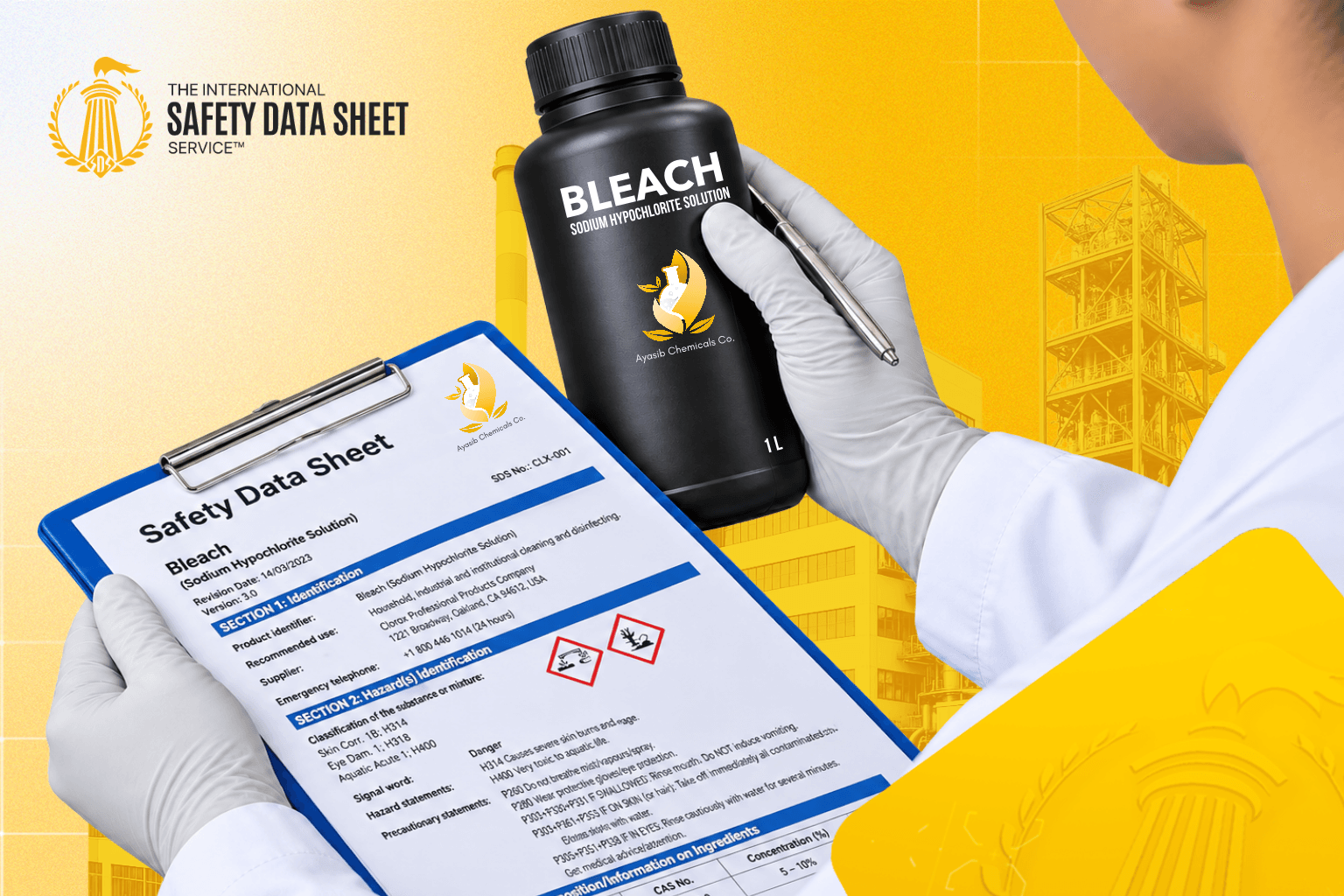
Sodium hypochlorite has a legally binding entry on HSE’s GB mandatory classification list. The solution is classified as corrosive to skin (Skin Corr. 1B, H314), causing serious eye damage (Eye Dam. 1, H318), and very toxic to aquatic life with long-lasting effects (H400, H410). The entry also carries EUH031, “Contact with acids liberates toxic gas”, for solutions of 5% or more.
Two details in that entry matter for bleach. It sets no special concentration limits for the skin or eye classes, so diluted products are classified using CLP’s general rules for mixtures. It also gives hypochlorite an M-factor of 10 for acute aquatic toxicity, which multiplies its weight in the environmental calculation. That is why aquatic hazard statements appear on so many bleach SDSs, and why Sections 12 and 13 matter for disposal. The entry is marked Note B, so when the solution is supplied as a substance its label must state the percentage concentration.
Why bleaches of similar strength classify differently
Three things decide where a particular bleach lands, and a different combination can give two similar-looking products different labels.
The first is concentration. Under the generic concentration limits in CLP Annex I, a mixture is classified as corrosive to skin when its corrosive ingredients add up to 5% or more, and as a skin irritant between 1% and 5%. The threshold for serious eye damage is lower, at 3%. So by calculation alone, a bleach with a little under 5% hypochlorite can come out as a skin irritant but still Eye Dam. 1. One UK household bleach SDS we checked is classified that way: H315 and H318.
The second is pH. In the absence of other information, CLP treats a mixture with a pH of 11.5 or above as corrosive to skin. A supplier can only classify it lower if other data, preferably a validated test, confirms it is not corrosive. Bleach is strongly alkaline, and the SDSs we checked gave pH values between 12 and 14. The thick bleach mentioned above, at 3 to 5% hypochlorite, is classified Skin Corr. 1 (H314). So is a trade spray cleaner whose SDS lists only 0.1 to 1% hypochlorite with a similar amount of sodium hydroxide, at pH 13.2.
The third is the other ingredients. Sodium hydroxide and many surfactants carry their own skin or eye classifications, and they are added into the same totals as the hypochlorite.
The practical lesson is that you cannot read the classification off the percentage. A weaker bleach can be more severely classified than a stronger one. Eye Dam. 1 is enough on its own to require the signal word Danger, which is why most bleach SDSs carry Danger even where the skin classification is only irritant. Section 2 is the answer; Sections 3 and 9 explain it.
The chlorine warnings and the mixing hazard
Two supplementary statements relate to the chlorine in bleach. Under GB CLP Annex II, any mixture sold to the public containing more than 1% active chlorine must carry EUH206: “Warning! Do not use together with other products. May release dangerous gases (chlorine).” EUH031 applies to the stronger solutions covered by the mandatory entry.
The reason is chemistry, not caution for its own sake. UKHSA notes that mixing bleach with acidic products produces chlorine gas, which at high concentrations can be fatal, and that mixing it with ammonia-based products produces chloramines, which are highly irritating to the airways. Acidic toilet and limescale cleaners are the usual culprits. Store bleach away from acids, as covered in our chemical storage checklist, and see Sodium Hypochlorite: Why Is It Dangerous? for the full hazard picture.
What to check on a bleach SDS
- Section 2: the full classification, including both the skin and the eye class, and any EUH031 or EUH206 statement.
- Section 3: the hypochlorite range and every other hazardous ingredient. Match each concentration limit to the row it sits under.
- Section 9: the pH. A value of 11.5 or above helps explain a corrosive classification at low hypochlorite content.
- Sections 4 and 10: first aid, and the incompatible materials, which for bleach should include acids.
- Section 8: the recommended eye and skin protection. Some SDSs also quote the EH40 short-term limit for chlorine, 0.5 ppm, because chlorine is the gas bleach releases if mixed with acid. Our Section 8 guide explains the rest.
- The revision date. Formulations change, and an SDS issued years ago may not describe today’s product; very old ones may even be titled MSDS, which our guide to SDS vs MSDS explains. Ask the supplier for the current version.
Applying bleach under a toilet rim, decanting it into a smaller container and dosing it into a process are different exposures, even with the same product. If staff dilute bleach before use, the diluted solution is also a different mixture from the concentrate, and the COSHH risk assessment should cover the strength actually being handled as well as the bottle it came from. Use the SDS for the exact product and supplier you hold. A bleach from another brand, or the same brand in a thick or spray version, can be classified differently.
Frequently Asked Questions
Is household bleach corrosive?
It depends on the product. Some household bleaches are classified as corrosive to skin (H314); others are classified as skin irritants (H315) but still cause serious eye damage (H318). Section 2 of the SDS tells you which applies.
Why does the bottle say “less than 5%” but the SDS gives a range?
The bottle follows the Detergents Regulation, which groups chlorine-based bleaching agents into broad bands. The SDS gives a narrower range in Section 3. Neither gives the exact recipe.
Does a stronger bleach always have a more severe classification?
No. A high pH or other ingredients such as sodium hydroxide can make a product with little hypochlorite corrosive, while a stronger household bleach may be classified only as a skin irritant.
What does EUH206 mean on a bleach label?
It warns not to use the product with other cleaners because it may release chlorine gas. It is required on mixtures sold to the public that contain more than 1% active chlorine.
Can I use one bleach’s SDS for another product?
No. Each SDS covers one supplier’s formulation. Thick, spray and regular versions of the same brand can have different ingredients, pH and classifications.
You Might Also Find Useful
Free SDS and Chemical Risk Assessments
Search more than 1.5 million Safety Data Sheets and linked Chemical Risk Assessments.
- ✓ Search by substance, product, or manufacturer
- ✓ Save documents to your library
- ✓ Register free in under two minutes