An Overview of Safety Data Sheets: The 16 Sections Explained
Most people working in an environment that uses chemicals have heard of Safety Data Sheets. They come up in training, audits and compliance checks. But ask someone to explain what is actually in one, or why it matters, and the answer is often vague.
This guide clears that up. It explains what a Safety Data Sheet is, who needs one, and walks through all 16 sections so you know exactly what information to expect and where to find it.
Safety Data Sheets are not something to be filed away and forgotten. They are the starting point for almost everything else in chemical safety, from risk assessments to PPE selection to training. Getting comfortable with what they contain makes everything that follows easier.
What is a Safety Data Sheet?
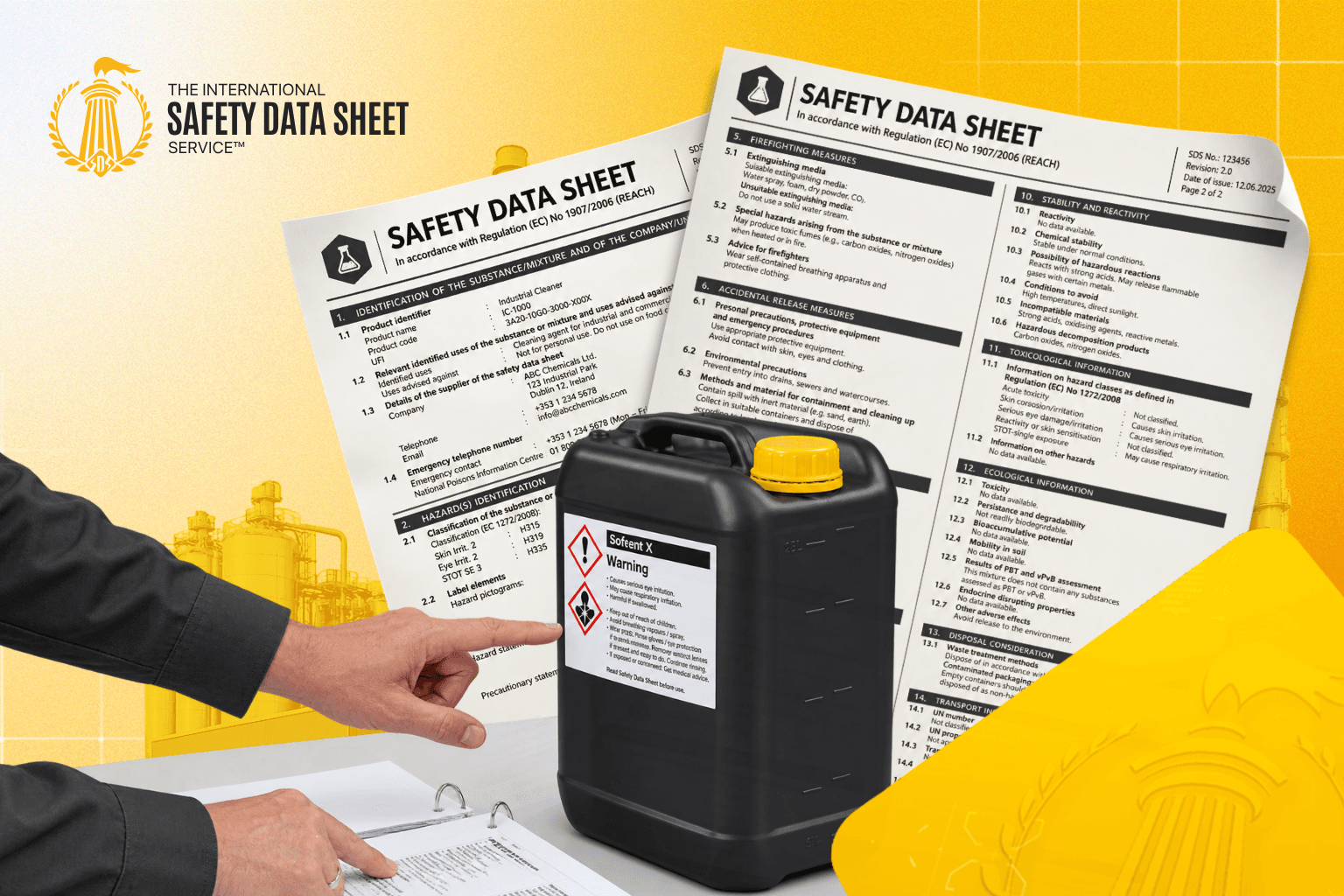
A Safety Data Sheet (SDS) is a technical document that provides detailed information about a specific hazardous substance or chemical product. It covers the substance's properties, the health and environmental hazards it presents, and the practical steps needed to handle, store, use and dispose of it safely. SDS documents are prepared by manufacturers and suppliers and are intended for anyone who may come into contact with the substance, from the people handling it day to day to the health and safety professionals responsible for workplace compliance. In the UK, the format and content of an SDS is governed by UK REACH (Registration, Evaluation, Authorisation and Restriction of Chemicals), which sets out a standardised 16-section structure that every SDS must follow. This means that whichever manufacturer or supplier a product comes from, the SDS will always be laid out in the same order, making it easier to find the information you need quickly.Why do you need an SDS?
Safety Data Sheets are a legal requirement for any UK workplace that uses or handles hazardous chemicals. Under the Control of Substances Hazardous to Health Regulations 2002 (COSHH), employers have a duty to:- Ensure employees have access to the SDS for every hazardous substance they may come into contact with
- Provide adequate training so workers understand how to read and apply the information in an SDS
- Follow the safety practices and control measures set out in the SDS, in line with guidance from the Health and Safety Executive (HSE)
Why this actually matters
The scale of the problem is part of why SDS compliance is taken so seriously. The Health and Safety Executive estimates that around 13,000 deaths in Great Britain each year are linked to past exposure to hazardous substances at work, the majority from occupational lung disease caused by dust, chemicals and asbestos. These are not sudden accidents. They are long-term health consequences that build up over years, often the result of poor information or inadequate controls at the time of exposure. Getting SDS management wrong has consequences well beyond a missing document. It can mean workers developing long-term health conditions, legal action and fines for the employer, and operational disruption when something does go wrong. Most of this is avoidable. It comes down to knowing what substances are actually on site, having accurate and current information available when people need it, and making sure workers understand what they are dealing with.Who needs Safety Data Sheets?
SDS requirements apply across virtually every sector where chemicals are used, stored or handled, and the obligations look slightly different depending on where you sit in a workplace.
Employers
Employers carry the main legal responsibility. They must identify hazardous substances on site, maintain access to current SDS documents, provide training, and ensure safe working practices are followed. Failing to meet these obligations is a compliance breach, and in serious cases can carry significant legal consequences.
Employees
Employees need to be able to read and understand the SDS for any substance they work with, follow the safety procedures it sets out, and use PPE correctly. Understanding an SDS is part of doing the job safely, not just a box to tick during induction.
Self-employed workers
SDS requirements apply regardless of how many people you employ. If you are self-employed and work with hazardous substances, the same standard applies to you as it would to a business with fifty staff.
Industries that rely on SDS most heavily
hile SDS requirements apply everywhere chemicals are used, some sectors depend on them particularly heavily, including manufacturing, construction, healthcare, food production, cleaning services, and laboratories and research facilities.Is an SDS hard to understand?
Not once you know what you are looking at. An SDS can look dense at first glance, but because every SDS follows the same 16-section structure, once you understand the format you can quickly find the information that matters most to you, whether that is first aid guidance, PPE requirements or storage instructions. Below is a section-by-section breakdown of what each part of an SDS covers.The 16 Sections of a Safety Data Sheet
Section 1: Identification
Identifies the product and the company. This includes the product name, the manufacturer or supplier's contact details, the recommended use of the substance, and an emergency contact number. If you need to call someone urgently about this substance, the number is here.Section 2: Hazard Identification
Sets out the classification of the substance under UK CLP (Classification, Labelling and Packaging) regulations. This is where you will find the GHS hazard pictograms, the relevant H-phrases (hazard statements) and P-statements (precautionary statements). This section gives you the fastest overview of how dangerous the substance is and what general precautions apply.Section 3: Composition and Information on Ingredients
Lists the chemical ingredients in the product, with particular focus on any components classified as hazardous. For mixtures, this section identifies which ingredients are responsible for the hazards described in Section 2.Section 4: First Aid Measures
Practical guidance on what to do if someone is exposed to the substance, broken down by route of exposure: inhalation, skin contact, eye contact and ingestion. This is the section to check immediately in the event of an exposure incident.Section 5: Firefighting Measures
Explains the correct extinguishing methods for a fire involving this substance, along with any specific hazards that may arise from combustion such as toxic fumes, and the protective equipment firefighters should use.Section 6: Accidental Release Measures
Covers what to do in the event of a spill or leak: the precautions needed, the cleanup methods recommended, and how to prevent the substance from spreading or contaminating other areas.Section 7: Handling and Storage
Guidance on how to handle the substance safely during normal use, and how it should be stored, including any substances it should not be stored near due to reactivity or incompatibility.Section 8: Exposure Controls and Personal Protection
One of the most practically important sections. This sets out any Workplace Exposure Limits (WELs) that apply, and specifies the personal protective equipment (PPE) required, such as respiratory protection, eye protection, gloves and protective clothing, based on how the substance is used.Section 9: Physical and Chemical Properties
Describes the substance's physical characteristics: appearance, odour, melting and boiling points, flammability, density and other measurable properties. Useful for understanding how the substance will behave in different conditions.Section 10: Stability and Reactivity
Identifies any conditions to avoid, such as heat, light or contact with specific materials, and any substances this product should not be mixed with due to the risk of dangerous reactions.Section 11: Toxicological Information
Details the health effects of exposure, both short-term (acute) and long-term (chronic). This is the section that underpins much of the hazard classification in Section 2 and is particularly important for understanding cumulative or delayed health risks.Section 12: Ecological Information
Covers the substance's potential impact on the environment, including toxicity to aquatic life, persistence, and how it behaves if released into soil or water.Section 13: Disposal Considerations
Guidance on how to dispose of the substance and its packaging safely and in line with UK waste regulations.Section 14: Transport Information
Covers the classification and requirements for transporting the substance, relevant if your business moves the product between sites or receives deliveries.Section 15: Regulatory Information
Lists any UK or international regulations specific to this substance beyond the general CLP classification, useful for confirming any additional compliance obligations.Section 16: Other Information
Includes administrative details such as the date the SDS was prepared or last revised, and any abbreviations or reference sources used throughout the document. Always check this section to confirm you are looking at the most current version.What an SDS makes possible
An SDS is not just a filing requirement. It is the foundation that everything else in chemical safety is built on. Without a current SDS for a substance, you cannot properly complete a COSHH risk assessment, select the correct PPE, train workers to handle the substance safely, or plan an effective response to a spill or exposure incident. Two practical habits follow from this. First, request the SDS from the manufacturer or supplier before a new substance is used for the first time, not after. Second, check that the SDS you are working from is still current. Manufacturers update SDS documents as hazard classifications and safety guidance change, and an SDS that was accurate three years ago may no longer reflect today's requirements.Getting the most out of an SDS
Reading all 16 sections in full every time you handle a substance is not always practical, but knowing the structure means you can go straight to what you need. Section 2 for a quick hazard overview, Section 4 in an emergency, Section 7 and Section 8 for day-to-day handling and PPE. The most important habit is checking Section 16 to confirm the SDS is current, and making sure the version your team is working from matches what is being used on site.Frequently Asked Questions
Are Safety Data Sheets legally required in the UK?
Yes. Under UK REACH, suppliers must provide an SDS for hazardous substances and mixtures where required, and employers must keep current copies accessible to anyone who works with them.
How often should a Safety Data Sheet be updated?
There's no fixed schedule. Manufacturers reissue an SDS whenever hazard classifications, legislation or recommended controls change. Always confirm you're working from the latest version.
Where do I find the revision date on an SDS?
Section 16, Other Information. Checking this section is the quickest way to confirm you're looking at the current version.
Can I use one Safety Data Sheet for multiple products?
Not usually. An SDS is prepared for a specific product, and even similar products from different manufacturers can differ in formulation or classification, so each should have its own SDS.
What should I do if a supplier doesn't provide an SDS?
Request it directly from the manufacturer or supplier before using the product. You can also search ISDSS by product name, manufacturer or product code, then match the document to the exact product and supplier.
You Might Also Find Useful
Free SDS and Chemical Risk Assessments
Search more than 1.5 million Safety Data Sheets and linked Chemical Risk Assessments.
- ✓ Search by substance, product, or manufacturer
- ✓ Save documents to your library
- ✓ Register free in under two minutes