White Spirit: Why Is It Dangerous?
A Category 3 flammable liquid should carry Warning on its own. White spirit carries Danger instead, because of two hazards most people never check, and that's a real lesson in how signal words work.
White spirit's flammability alone would only earn a Warning label. It's classed as a Category 3 flammable liquid under GB CLP, the mildest of the three flammable liquid categories, the same tier as many paints and adhesives. But the signal word on a real white spirit SDS is Danger, and the reason has almost nothing to do with fire. Two other hazards drive that label: what happens if it's swallowed, and what repeated exposure can do to the nervous system over time. How serious any of this is in practice also depends on dose, route and task, brushing a little on in a ventilated room is a very different exposure from spraying a solvent-based coating in a small enclosed space.
What White Spirit Actually Is
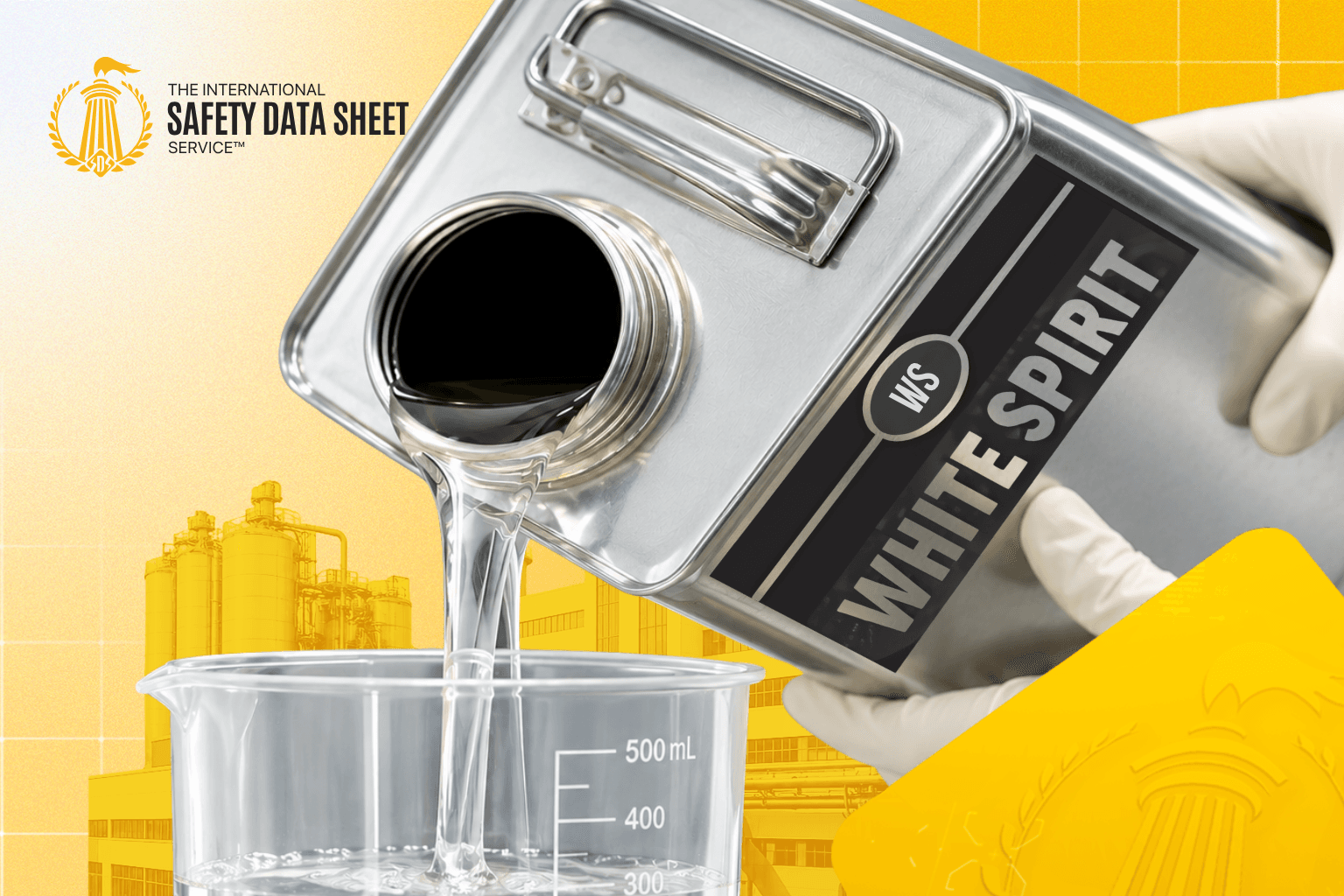
White spirit isn't one fixed chemical the way isopropyl alcohol is. It's a mixture of petroleum hydrocarbons, refined to a fairly narrow boiling range, and UKHSA lists its other names as Stoddard solvent, turpentine substitute, mineral spirit and paint thinner, with uses in paints, coatings, varnishes, adhesives and printing inks, alongside cleaning and degreasing. Several distinct types exist, differing mainly in aromatic content, which is why there's no single CAS number covering all of it and why the low-aromatic “odourless” variants sold for indoor use carry a somewhat different profile. Because it's a mixture rather than one substance, the label and current SDS for the specific product you buy are the reliable source, not a general description.
The Two Hazards That Actually Drive Danger
A current white spirit SDS typically carries these hazard statements:
- H226: Flammable liquid and vapour (Flam. Liq. 3)
- H304: May be fatal if swallowed and enters airways (Asp. Tox. 1)
- H336: May cause drowsiness or dizziness
- H372: Causes damage to organs through prolonged or repeated exposure
- H411: Toxic to aquatic life with long lasting effects
- EUH066: Repeated exposure may cause skin dryness or cracking
That's one product's typical profile, verified across multiple independent current UK supplier SDSs, not a rule for every white spirit on the market, individual products can and do vary. H226 on its own is Warning-tier. But H372 and H304 are both Danger-tier hazards in their own right, and GB CLP's rule is that the most severe classification anywhere on the SDS sets the overall signal word. White spirit is a genuine real-world case of that rule in action: a mid-range flammable liquid that carries Danger because of what else is on the label, not because of the fire risk at all.
Fire, Vapour and Swallowing: The Three Immediate Hazards
Vapour can ignite near an ignition source, more likely in enclosed or poorly ventilated areas, with spraying or during large-scale cleaning. Fire and explosion risk falls under DSEAR as well as COSHH, and storage is part of this: HSE recommends keeping no more than 50 litres of a flammable liquid in a workroom where its flash point is below the workroom's maximum ambient temperature, or up to 250 litres for other flammable liquids with a flash point up to 60°C (white spirit typically sits around 38–40°C), figures HSE calls recommended maxima rather than absolute limits. Rags soaked in white spirit are a genuine fire risk, but through ordinary flammability, not the self-heating spontaneous combustion associated with drying-oil-soaked rags like linseed oil, white spirit isn't prone to that. Store used rags in a closed container rather than leaving them near anything that could ignite them.
Breathed in, the vapour irritates the nose, throat and lungs; UKHSA lists shortness of breath, dizziness, headache, lack of coordination and drowsiness, with very high concentrations producing symptoms similar to swallowing it. Dizziness is a second hazard for anyone working at height or near moving machinery. Spraying produces the highest exposures, and mechanical or local exhaust ventilation may be needed for higher-risk work.
Swallowed, white spirit causes stomach upset and, in severe cases, drowsiness, fits or coma. The greater danger, though, is to the lungs rather than the stomach: if swallowed liquid is inhaled directly, for example while vomiting, UKHSA states severe lung damage called pneumonitis can occur. This is what H304 warns about, and it's why supplier SDSs consistently instruct do not induce vomiting, seek medical advice immediately instead. Keep it in its original labelled container, decanting into drinks bottles is how accidental ingestion tends to happen.
Skin, Eyes and Long-Term Exposure
On skin, UKHSA describes irritation, drying and cracking, with prolonged contact able to cause redness, blistering and burns; in the eyes it causes immediate stinging and tearing. Repeated contact can lead to dermatitis. Glove choice needs care, match the breakthrough time and permeation rate to the task, since single-use nitrile gloves aren't adequate for every solvent, and don't use white spirit itself to clean skin, wash product off with soap and water instead.
H372 is a slower, cumulative risk: prolonged or repeated vapour exposure is linked to central nervous system effects, historically described in decorators as “painter's syndrome”, memory and concentration problems built up over years of poorly ventilated solvent use, alongside a general risk of long-term liver or kidney effects from repeated solvent exposure. Routine low-level use, cleaning brushes in a small room every day, deserves as much attention in a COSHH assessment as an obvious spill. Environmentally, H411 formulations are toxic to aquatic life long-term, so don't pour it down a drain; check Sections 12 and 13 of the SDS for disposal.
Why There's No Single Exposure Limit to Check
Unlike isopropyl alcohol, which has a fixed workplace exposure limit in HSE's EH40 list, white spirit doesn't appear in EH40's Table 1 at all. Because it's a variable mixture rather than one substance, HSE instead sets out a reciprocal calculation procedure (§85–89) that lets each supplier work out an in-house exposure limit for their specific blend, based on its aliphatic, cycloaliphatic and aromatic content. EH40's own worked example for white spirit arrives at 550 mg/m³ for one particular formulation, and real supplier SDSs list their own calculated figures in Section 8, typically somewhere in the 350–600 mg/m³ range depending on the exact formulation. That means the exposure limit on the bottle in front of you is specific to that product, not a fixed number you can memorise once, and any limit is a ceiling, not a target: COSHH still requires exposure to be reduced as far as reasonably practicable.
What COSHH Requires
Where white spirit is used at work, the employer must assess the risk and act on it. Regulation 7 of COSHH requires exposure to be prevented or, where that's not reasonably practicable, adequately controlled. Substitution is preferred, a water-based paint or a cleaning method that avoids solvent altogether. Where exposure can't be prevented, Regulation 7 sets an order of priority: engineering controls and good work processes first, then control at source such as ventilation, with PPE added only where adequate control can't be achieved by other means. Simple controls include keeping lids on containers, using the minimum amount for the job, and not leaving solvent-soaked rags lying around. The SDS feeds into a COSHH risk assessment but doesn't replace it.
For the full SDS, these sections matter most: Section 2 (classification and hazard statements), Section 4 (first aid, including ingestion advice), Section 7 (handling and storage), Section 8 (exposure limits and PPE), Section 9 (flash point), Section 11 (toxicological information) and Sections 12–13 (environmental effects and disposal).
What to Do After Accidental Exposure
Move away from the source, then: if swallowed, seek medical advice and do not make yourself sick; if breathed in, seek medical advice; for skin contact, wash with lukewarm water and soap for 10–15 minutes and seek medical advice; for eye contact, remove contact lenses, irrigate with lukewarm water for 10–15 minutes and seek medical advice. Follow Section 4 of the product SDS and the site's emergency procedures; for larger releases or fires, UKHSA's incident management guidance covers the emergency response.
Frequently Asked Questions
Why does white spirit carry Danger if it's only a Category 3 flammable liquid?
Because flammability isn't its only hazard. It also typically carries H372 (organ damage from repeated exposure) and H304 (aspiration hazard if swallowed), both Danger-tier classifications in their own right. Under GB CLP, the most severe hazard anywhere on the SDS sets the overall signal word, so Danger applies even though the flammability alone would only be Warning.
What's the workplace exposure limit for white spirit?
There isn't one fixed figure. White spirit is a variable hydrocarbon mixture rather than a single substance, so it has no entry in HSE's EH40 Table 1. Each supplier calculates an in-house limit for their specific blend under EH40's reciprocal calculation procedure, typically in the 350–600 mg/m³ range, listed in Section 8 of that product's own SDS.
What happens if you swallow white spirit?
The main risk isn't poisoning in the usual sense, it's aspiration. If the liquid enters the lungs, which can happen easily during swallowing or vomiting, it can cause chemical pneumonitis, a severe lung injury. This is why SDSs specifically instruct not to induce vomiting, and to seek medical advice immediately instead.
Does a dust mask protect against white spirit vapour?
No. Particulate filters protect against spray mist but not solvent vapours. Respiratory protection needs a filter suitable for solvent vapour, and wearers of tight-fitting masks must be fit tested. Section 8 of the SDS and the COSHH assessment should set out what's actually needed.
What should I do with rags soaked in white spirit?
Don't leave them lying around, they keep releasing vapour and are a real fire risk through ordinary flammability, not through the self-heating spontaneous combustion associated with drying-oil-soaked rags like linseed oil. Put them in a closed container and dispose of them in line with Section 13 of the SDS and your site's waste arrangements.
You Might Also Find Useful
Free SDS and Chemical Risk Assessments
Search more than 1.5 million Safety Data Sheets and linked Chemical Risk Assessments.
- ✓ Search by substance, product, or manufacturer
- ✓ Save documents to your library
- ✓ Register free in under two minutes