Isopropyl Alcohol: Why Is It Dangerous? Understanding the SDS Hazards
Three separate hazard statements put isopropyl alcohol in the Danger category under GB CLP, not the milder Warning some people expect from a cleaning solvent.
On this page
- What Isopropyl Alcohol Actually Is
- The Three Hazards Its SDS Is Built Around
- Why the Flash Point Matters More Than People Expect
- What the Workplace Exposure Limit Tells You
- What This Means for Your COSHH Assessment
- What to Do If Someone Is Overexposed
- When a Product Only “Contains” Isopropyl Alcohol
- External References
- Frequently Asked Questions
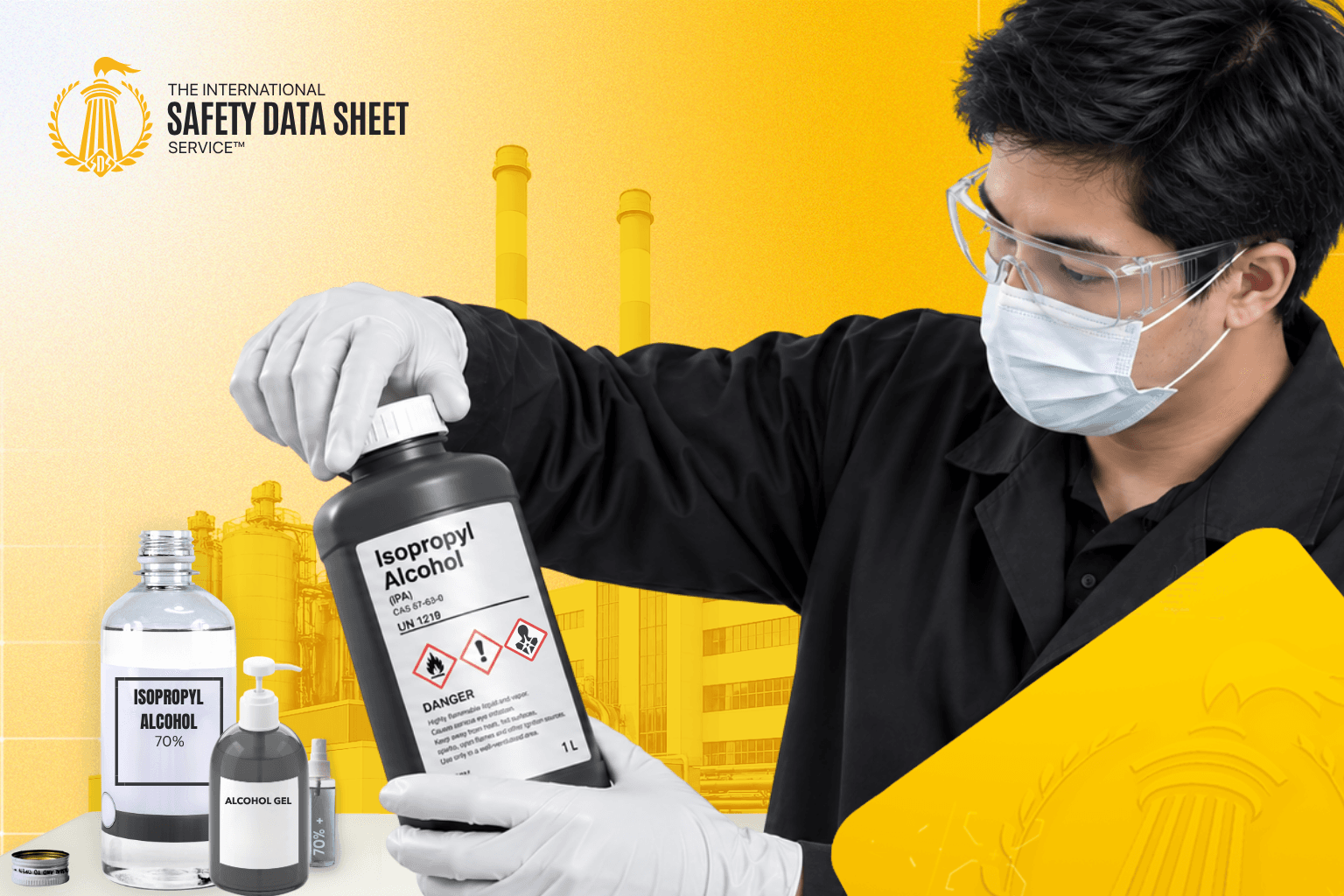
Isopropyl alcohol is classed as a highly flammable liquid, an eye irritant, and a substance that can cause drowsiness or dizziness at high vapour concentrations. Those three hazards, not any single one of them, are what its Safety Data Sheet is built to warn you about, and each one changes what you need to do before you store, handle or work with it.
It's one of the most common substances in UK workplaces, present in everything from surface disinfectants and hand sanitisers to screen cleaners and lab reagents, which makes it easy to treat as low-risk simply because it's familiar. The hazard data says otherwise.
What Isopropyl Alcohol Actually Is
Isopropyl alcohol (IPA) is also labelled propan-2-ol or 2-propanol on a Safety Data Sheet, all three names refer to the same substance, CAS number 67-63-0. It's a colourless, fast-evaporating liquid with a sharp, alcoholic smell, valued in workplaces precisely because it evaporates quickly and dissolves grease, oils and many contaminants without leaving a residue.
That's why it turns up in hand sanitisers and surface disinfectants at concentrations typically between 60% and 90%, in electronics and screen cleaning products, in printing and coating processes, and as a general-purpose solvent in labs and workshops. Most people handling it day to day have never read its SDS, because the products it's sold in look and feel like everyday cleaning supplies.
The Three Hazards Its SDS Is Built Around
Section 2 of an isopropyl alcohol SDS carries a signal word of Danger, driven by three hazard statements:
- H225 — Highly flammable liquid and vapour
- H319 — Causes serious eye irritation
- H336 — May cause drowsiness or dizziness
H225 carries the most weight in that list. Isopropyl alcohol has a flash point of roughly 12–13°C, well below room temperature, which means it can give off enough vapour to ignite even when the liquid itself feels cool to the touch. That single figure is what pulls a product's storage and handling requirements into DSEAR territory alongside COSHH, and it's the detail most likely to get missed when a product is treated as “just a cleaner.”
H319 and H336 are health hazards rather than physical ones. Eye contact with the liquid or splashing during use can cause real irritation, and breathing in enough vapour, most likely in a small, poorly ventilated room, can bring on the kind of drowsiness or lightheadedness people sometimes describe as feeling “spaced out” partway through a task. Neither is usually severe on its own, but both are the kind of thing a COSHH assessment exists to catch before it affects someone's judgement or coordination.
Why the Flash Point Matters More Than People Expect
A flash point below 23°C puts isopropyl alcohol in the same regulatory bracket as substances most people would immediately recognise as flammable, petrol included. Its vapour is also heavier than air, so in an enclosed or poorly ventilated space it can settle and accumulate near floor level rather than dispersing, sitting quietly until it reaches an ignition source such as a spark, a hot surface, or static discharge.
This is the practical reason DSEAR sits alongside COSHH for this substance. COSHH covers the health risk from exposure; DSEAR covers the fire and explosion risk from the vapour itself. Where isopropyl alcohol is used, stored, or decanted in any real quantity, both need considering together, not as a choice between them.
What the Workplace Exposure Limit Tells You
HSE's EH40 list of workplace exposure limits sets a WEL for propan-2-ol of 400 ppm (999 mg/m³) as an 8-hour time-weighted average, with a short-term limit of 500 ppm (1250 mg/m³) over 15 minutes. Those figures exist because H336 is a real effect at real concentrations, not a formality on the label.
In practice, exposure this high is unlikely from occasional use of a hand sanitiser or wipe. It becomes a genuine concern in settings where the substance is used in volume with limited ventilation, cleaning large surface areas in a small room, decanting from bulk containers, or running a process that keeps vapour in the air for extended periods. If people doing that kind of work report headaches, drowsiness or irritation partway through a shift, the WEL is the number a COSHH assessment should be checked against.
What This Means for Your COSHH Assessment
The Control of Substances Hazardous to Health Regulations 2002 require an employer to prevent exposure where reasonably practicable, and to adequately control it where prevention isn't possible. For isopropyl alcohol, that duty usually plays out as a mix of ventilation, sensible storage, and matching the task to the right form of the product rather than reaching for the most concentrated version by default.
For most low-volume office or retail use, such as hand sanitiser at a till point, the practical controls are minimal: keep containers closed when not in use, avoid pooling near heat sources, and don't decant into unlabelled bottles. For higher-volume or industrial use, ventilation becomes the main control, alongside keeping stock away from ignition sources and out of direct sunlight, since heat lowers the vapour needed to reach a flammable concentration.
What to Do If Someone Is Overexposed
The response to overexposure follows the hazard, not a generic first-aid routine. For eye contact, remove contact lenses if present and irrigate with water for several minutes, then seek medical advice if irritation doesn't settle. For inhalation, move the person to fresh air immediately and let them rest somewhere ventilated, most cases of mild drowsiness resolve on their own once someone is away from the vapour.
The more urgent version of this is a spill in a confined space. A large quantity of isopropyl alcohol released somewhere with poor airflow can raise vapour concentration quickly, at which point the flammability risk and the health risk escalate together. This is why spill procedures for larger volumes usually call for evacuating and ventilating the area before anyone goes back in to clean up, rather than treating it as a simple wipe-up job.
When a Product Only “Contains” Isopropyl Alcohol
A pure isopropyl alcohol SDS and the SDS for a product that merely contains it as one ingredient are not interchangeable. Concentration changes the classification: a hand sanitiser at 70% IPA may carry the same flammability warning as the pure substance, while a wipe or spray with a much lower concentration may not meet the threshold for H225 at all.
This is the detail worth checking on the actual product SDS rather than assuming from the substance name on the label. The classification, WEL relevance and DSEAR status all follow the specific formulation, not the ingredient in isolation, so the safe move is always to check the SDS for the product actually in use rather than substitute what's true for the pure substance.
External References
Frequently Asked Questions
Is isopropyl alcohol classed as a flammable liquid?
Yes. It carries hazard statement H225, “highly flammable liquid and vapour,” because its flash point sits at roughly 12–13°C, well below room temperature. This is also why DSEAR applies alongside COSHH wherever it's stored or used in meaningful quantity.
What's the workplace exposure limit for isopropyl alcohol?
HSE's EH40 sets a WEL of 400 ppm (999 mg/m³) as an 8-hour time-weighted average, with a short-term limit of 500 ppm (1250 mg/m³) over 15 minutes. Above these levels, drowsiness and dizziness (H336) become more likely.
Does hand sanitiser count as a hazardous substance under COSHH?
Most alcohol-based hand sanitisers are classed as hazardous under COSHH because of their flammability, though the risk from occasional low-volume use is low. Check the specific product's SDS rather than assuming, since concentration affects classification.
Why does isopropyl alcohol cause dizziness?
Breathing in enough vapour has a narcotic effect on the central nervous system, which HSE's classification captures as H336, “may cause drowsiness or dizziness.” It's most likely in small, poorly ventilated spaces where vapour has nowhere to disperse.
Does DSEAR apply to small quantities of isopropyl alcohol?
DSEAR applies wherever a dangerous substance is present at work, but the level of control expected scales with the real fire risk. A single bottle of hand sanitiser needs far less than a store cupboard of bulk IPA, though basic precautions such as keeping it away from ignition sources still apply either way.
You Might Also Find Useful
Free SDS and Chemical Risk Assessments
Search more than 1.5 million Safety Data Sheets and linked Chemical Risk Assessments.
- ✓ Search by substance, product, or manufacturer
- ✓ Save documents to your library
- ✓ Register free in under two minutes