SDS vs MSDS: What's the Difference?
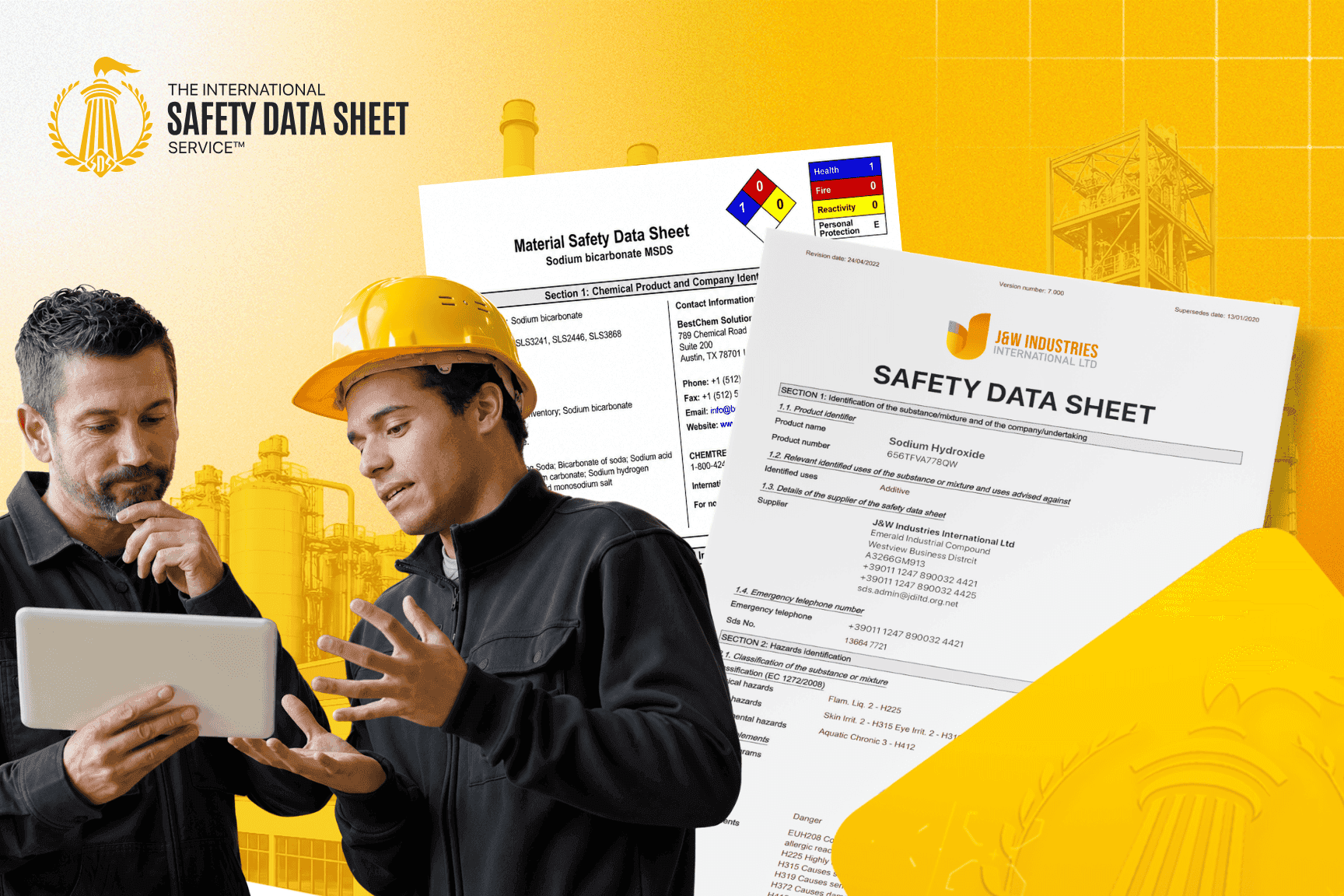
MSDS and SDS are not the same document, even though the terms get used interchangeably. An MSDS (Material Safety Data Sheet) was the older format used before 2015, with no fixed structure and content that varied by manufacturer. An SDS (Safety Data Sheet) is the current, standardised format, built around the same 16 sections in the same order every time, regardless of who produced it.
If you are still calling your safety documents "MSDS," you are using outdated terminology, but it usually still means the same physical document, just an older version of it. Here is what changed, when it changed, and why it still matters today.
What Is an MSDS?
MSDS stands for Material Safety Data Sheet, the standard term for chemical hazard documentation in the UK before the current SDS format came in. Legal duties to supply safety information on hazardous substances go back further still, to 1988 and the Chemicals (Hazard Information and Packaging) Regulations (CHIP) in 1994, but these older documents had no fixed structure. Different manufacturers organised the same kind of information in different orders, under different headings, with no guarantee that a fire-fighting section would appear before or after a first-aid section.
That inconsistency made cross-referencing a genuine headache. A safety officer comparing two products from different suppliers had to read the whole document each time, since there was no consistent layout to fall back on.
What Is an SDS?
An SDS, a Safety Data Sheet, is what replaced the MSDS: a fixed 16-section structure defined under the UN's Globally Harmonized System (GHS) and written into UK law via the CLP Regulation, which came into force on 20 January 2009.
The switch was phased rather than immediate. Pure substances moved to the new format earlier, and the deadline for mixtures was 1 June 2015, with transitional arrangements running to 1 June 2017 for certain existing stock. Today, every SDS, regardless of manufacturer, country of origin, or product type, follows that same 16-section order, governed by UK REACH Annex II.
Why Did the Format Change From MSDS to SDS?
The driving reason was alignment. Before GHS, manufacturers in different countries used different classification systems, different pictograms, and different document structures for what were often the same hazards, which made the old MSDS approach hard to compare across borders or even across suppliers in the same country.
GHS fixed that by standardising the hazard pictograms, the signal words (Danger or Warning), the H-phrases and P-statements, and the section order, all used worldwide. An SDS produced in the UK, the EU, or the US should now communicate hazards in a recognisably similar way, even though the regulations behind each remain legally separate.
Is There an Actual Difference in Content, or Just the Name?
Both changed, not just the label. A few concrete differences:
- MSDS documents had no fixed section order or required format.
- SDS documents follow the same 16 sections, in the same order, without exception.
- GHS hazard pictograms and standardised H-phrases and P-statements are an SDS requirement; MSDS documents often relied on manufacturer-specific wording instead.
- Update obligations under UK REACH Annex II apply to an SDS in a way they never applied to the looser MSDS requirements.
Does Anyone Still Use the Term MSDS?
Plenty of people do, mostly out of habit. Older training materials, legacy paperwork, and everyday conversation still default to it, including among experienced safety professionals, and it rarely causes confusion since everyone generally understands what is meant. The real issue only shows up if a business is still working from a physically outdated MSDS-format document rather than its current SDS equivalent, since that older paperwork may not reflect the substance's current classification or latest hazard data.
If you are ever unsure whether a document in your files is genuinely current or just an old MSDS in disguise, check Section 16 for a revision date and Section 2 for GHS-aligned hazard pictograms. Neither present usually means the document predates the current format and needs replacing.
Why This Still Matters in 2026
Chemical classifications do not stand still, and SDS documents have to keep up. The UK's Mandatory Classification and Labelling (MCL) list gets updated periodically, and the current update cycle requires affected products to carry updated labels and SDS documents by 15 August 2026, with a further deadline running into early 2027 for substances added in the most recent edition. An SDS that has not been reviewed recently can already be carrying out-of-date classification information, even while technically sitting in the correct 16-section format.
The practical difference the format change makes is clearest with substances that carry serious health risks. Take isocyanates, widely used in spray paints, adhesives and foam insulation: the standardised SDS for an isocyanate-based product places the respiratory sensitisation hazard and the required PPE in predictable locations (Section 2 and Section 8 respectively), so a safety officer or worker can find that information quickly and consistently, regardless of which manufacturer produced the document. Under the old MSDS system, the same information might have been buried, labelled differently, or absent entirely. The HSE's guidance on isocyanates illustrates exactly why consistent hazard communication matters for this category of substance, where occupational asthma is a genuine and irreversible risk if controls are not applied correctly.
Which is the real point behind all of this: having access to a current, up-to-date Safety Data Sheet matters far more than what you call the document. Whether someone says SDS or MSDS, what they hand you needs to be accurate today, not five years ago.
Frequently Asked Questions
Is MSDS the same as SDS?
They are related but not identical. MSDS was the older, unstructured format used before 2015; SDS is the current, standardised 16-section format required under UK REACH. People still use the terms interchangeably in conversation, but they describe two different document standards.
When did the UK switch from MSDS to SDS?
Under the CLP Regulation, which came into force in January 2009, with the deadline for mixtures falling on 1 June 2015. Transitional provisions for existing stock ran until 1 June 2017.
Why do people still say MSDS if it is outdated?
Mostly habit. The term was standard for decades, so plenty of training materials, internal paperwork, and day-to-day conversation never quite caught up. It is not usually a problem in practice, as long as the actual document being referenced is a current SDS rather than an old, unstructured MSDS.
How can I tell if a document is an outdated MSDS rather than a current SDS?
Look for a revision date in Section 16 and GHS hazard pictograms with standardised H-phrases in Section 2. Missing either, or a layout that does not follow the standard 16 sections, usually means you are holding an outdated document that needs replacing.
Does the MSDS to SDS change affect what information is included?
It does. SDS documents carry standardised GHS hazard pictograms, signal words, and H/P-phrases that older MSDS paperwork often lacked or presented inconsistently, simply because no fixed format existed to require them.
You Might Also Find Useful
Free SDS and Chemical Risk Assessments
Search more than 1.5 million Safety Data Sheets and linked Chemical Risk Assessments.
- ✓ Search by substance, product, or manufacturer
- ✓ Save documents to your library
- ✓ Register free in under two minutes