Sodium Hypochlorite (Bleach): Why Is It Dangerous? Understanding the SDS Hazards
Household bleach can be corrosive enough to carry a Danger label, and mixing it with the wrong cleaner releases toxic gas, two hazards easy to miss on a familiar product.
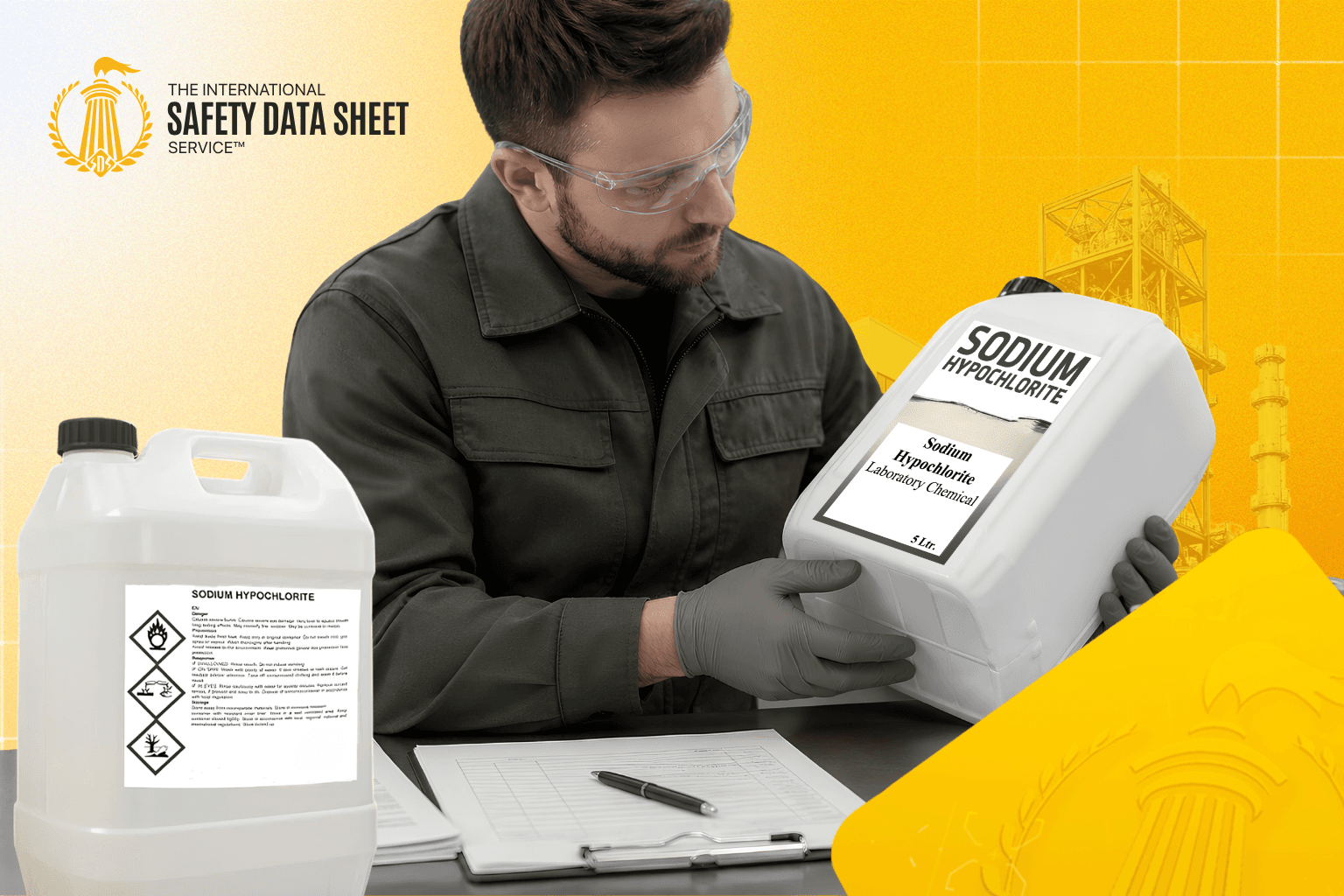
Sodium hypochlorite, the active ingredient in household and industrial bleach, can be corrosive to skin and eyes depending on the formulation, and it reacts with common acidic and ammonia-based products to release toxic gas. Neither hazard depends on it being a strong industrial product. Ordinary household bleach can carry both. Check the SDS for the exact bleach you use.
It's one of the most familiar products in any workplace, which is exactly why its SDS is worth reading rather than assumed. Unlike isopropyl alcohol, bleach isn't flammable. Its risks come from corrosion, gas release, and what happens when it meets the wrong product next to it on a shelf.
What Sodium Hypochlorite Actually Is
Sodium hypochlorite (CAS 7681-52-9) is sold for cleaning as a water-based solution, described on labels and SDSs by its percentage of sodium hypochlorite or “available chlorine.” These are not interchangeable figures. Household bleach varies in strength. Concentrated or industrial versions, and swimming pool or water-treatment grades, can be produced at higher strengths.
That percentage is the detail most people never check, and it's also the single biggest factor in how hazardous a specific bottle actually is. Two products both labelled “bleach” can carry meaningfully different hazard classifications depending on it.
Beyond general cleaning, sodium hypochlorite solution turns up in food-contact surface sanitising, laundry whitening, swimming pool and water treatment, and wastewater disinfection. Each of these settings tends to use a different strength for a reason, water treatment grades are formulated for controlled dosing rather than direct application, so a product moved between settings without checking its SDS is one of the more common ways someone ends up using a much stronger solution than the task actually needs.
The Hazard That Changes With Concentration
The GB mandatory classification entry for sodium hypochlorite solution (index 017-011-00-1) includes:
- Skin Corr. 1B, H314: causes severe skin burns and eye damage
- Eye Dam. 1, H318: causes serious eye damage
- Aquatic Acute 1, H400, and Aquatic Chronic 1, H410: hazards to aquatic life
The entry also specifies EUH031, “contact with acids liberates toxic gas,” at 5% active chlorine and above. It does not set the 0.5–2%, 2–5% and 5%-plus skin-hazard bands: those belong to sodium hydroxide (index 011-002-00-6). Finished bleach mixtures must be classified for their actual formulation, not by borrowing those bands.
For example, the UK SDS for Domestos Professional Original lists Skin Corr. 1B, H314, Eye Dam. 1, H318, and the signal word Danger. Chemos’s 1% active-chlorine solution instead lists Skin Irrit. 2, H315, Eye Irrit. 2, H319, and Warning. These are product examples, not universal cut-offs. H318 can itself require Danger even when a product is not classified as corrosive to skin. Use Section 2 of the exact product SDS.
The Warning Most People Skip: Don't Mix It
Two supplementary hazard statements to look for, where applicable, are EUH031, “contact with acids liberates toxic gas,” and EUH206, “Warning! Do not use together with other products. May release dangerous gases (chlorine).” These aren't boilerplate. They describe a genuine chemical reaction that can happen when bleach meets an acidic cleaner, such as a limescale remover or a descaler, releasing chlorine gas directly. EUH206 is used on consumer active-chlorine product labels; do not assume both statements appear on every SDS.
The same caution extends to ammonia-based products, common in some glass and multi-surface cleaners, which react with bleach to form chloramine gases rather than chlorine itself, with a similar set of respiratory effects. In both cases, the danger isn't in either product alone. It's in the reaction between them, which is why COSHH assessments involving bleach need to look at what else is stored or used nearby, not just the bottle itself.
What Exposure to the Released Gas Looks Like
HSE's EH40 list of workplace exposure limits sets a WEL for chlorine gas of 0.5 ppm (1.5 mg/m³), and lists it only as a 15-minute short-term limit, with no separate 8-hour long-term figure. An absent long-term limit does not mean prolonged exposure is safe; exposure still needs to be prevented or adequately controlled.
In practice, this matches how chlorine gas incidents from cleaning actually happen. A brief, unplanned mixing event, in a cupboard, a bathroom, or a closed cleaning trolley, can release enough gas in a small space to irritate eyes, nose, and throat within seconds, well before anyone realises what's happened. It's an acute risk from a single mistake, not a gradual one from routine handling.
What This Means for Your COSHH Assessment
The Control of Substances Hazardous to Health Regulations 2002 duty to prevent or adequately control exposure applies here in a very specific way: the main control isn't PPE or ventilation, it's segregation. Storing bleach away from acidic and ammonia-based products, never decanting it into a bottle that previously held something else, and training anyone who cleans with it to never combine products “to clean better” covers most of the real-world risk.
Skin and eye protection still matter for the corrosive hazard itself, gloves and eye protection for anything beyond brief, dilute contact, and good ventilation in any space where it's used in volume. But the single control that prevents the most serious incidents is simple: never mix cleaning products, and store them so an accidental mix can't happen either.
Handling and Disposal
The mandatory sodium hypochlorite entry also carries H400 and H410, very toxic to aquatic life, with long-lasting effects in the case of H410. A finished mixture’s aquatic classification can differ, so check its SDS. This matters for anyone disposing of bleach or dealing with a spill outdoors or near drains. Bulk quantities and any spill that could reach a watercourse should be treated as a disposal question in their own right, not flushed as a matter of course. Keep spills and unused bleach out of drains and watercourses, and follow Section 13 of the product SDS and applicable local disposal requirements.
What to Do If Someone Is Exposed
For skin or eye contact with a corrosive-strength solution, the response is immediate and sustained irrigation. For skin contact, remove contaminated clothing and wash the affected area with lukewarm water and soap for at least 10 to 15 minutes. For eye contact, remove contact lenses if easily possible and rinse with lukewarm water for at least 10 to 15 minutes. Seek medical attention; corrosive-product SDSs may require an immediate call to a poison centre or doctor. Delaying rinsing to find the exact product label first is the wrong order of priorities; the water goes on straightaway, the checking happens after.
For a mixing incident that has released chlorine or chloramine gas, the priority is getting people into fresh air immediately if safe to do so, not attempting to identify or neutralise the gas at source. Do not re-enter a contaminated space to ventilate it. Anyone exposed should seek medical advice rather than simply waiting for symptoms to pass. Breathing difficulty or severe symptoms require emergency assistance; symptoms can be delayed.
Frequently Asked Questions
Is bleach corrosive or just an irritant?
It depends on concentration and formulation. Some household bleach products are classed as corrosive, H314, causing severe skin burns and eye damage, not merely an irritant. Others carry an irritant classification. Check Section 2 of the exact product SDS rather than applying a universal concentration band.
Why shouldn't you mix bleach with other cleaning products?
EUH031 and EUH206, where applicable, warn about exactly this: mixing with acidic cleaners releases toxic chlorine gas, and mixing with ammonia-based products releases chloramine gases. Both can cause serious respiratory irritation from a single accidental mixing event.
What's the exposure limit for chlorine gas?
HSE's EH40 sets a workplace exposure limit of 0.5 ppm (1.5 mg/m³) as a 15-minute short-term limit, with no separate long-term average. An absent long-term limit does not mean prolonged exposure is safe.
Does household bleach need a COSHH assessment?
Yes, if its use or storage at work could expose people to a substance hazardous to health. Irritant as well as corrosive household-strength bleach can fall under COSHH, regardless of how routine or low-volume the use is.
Is sodium hypochlorite classed as flammable?
No. Unlike solvents such as isopropyl alcohol, sodium hypochlorite solution is not generally classified as flammable. Its risks include corrosion, gas release on mixing, and aquatic toxicity. Non-flammability does not automatically exclude DSEAR: it also covers substances corrosive to metals, and some bleach SDSs carry H290. Check the exact product SDS.
You Might Also Find Useful
Free SDS and Chemical Risk Assessments
Search more than 1.5 million Safety Data Sheets and linked Chemical Risk Assessments.
- ✓ Search by substance, product, or manufacturer
- ✓ Save documents to your library
- ✓ Register free in under two minutes