
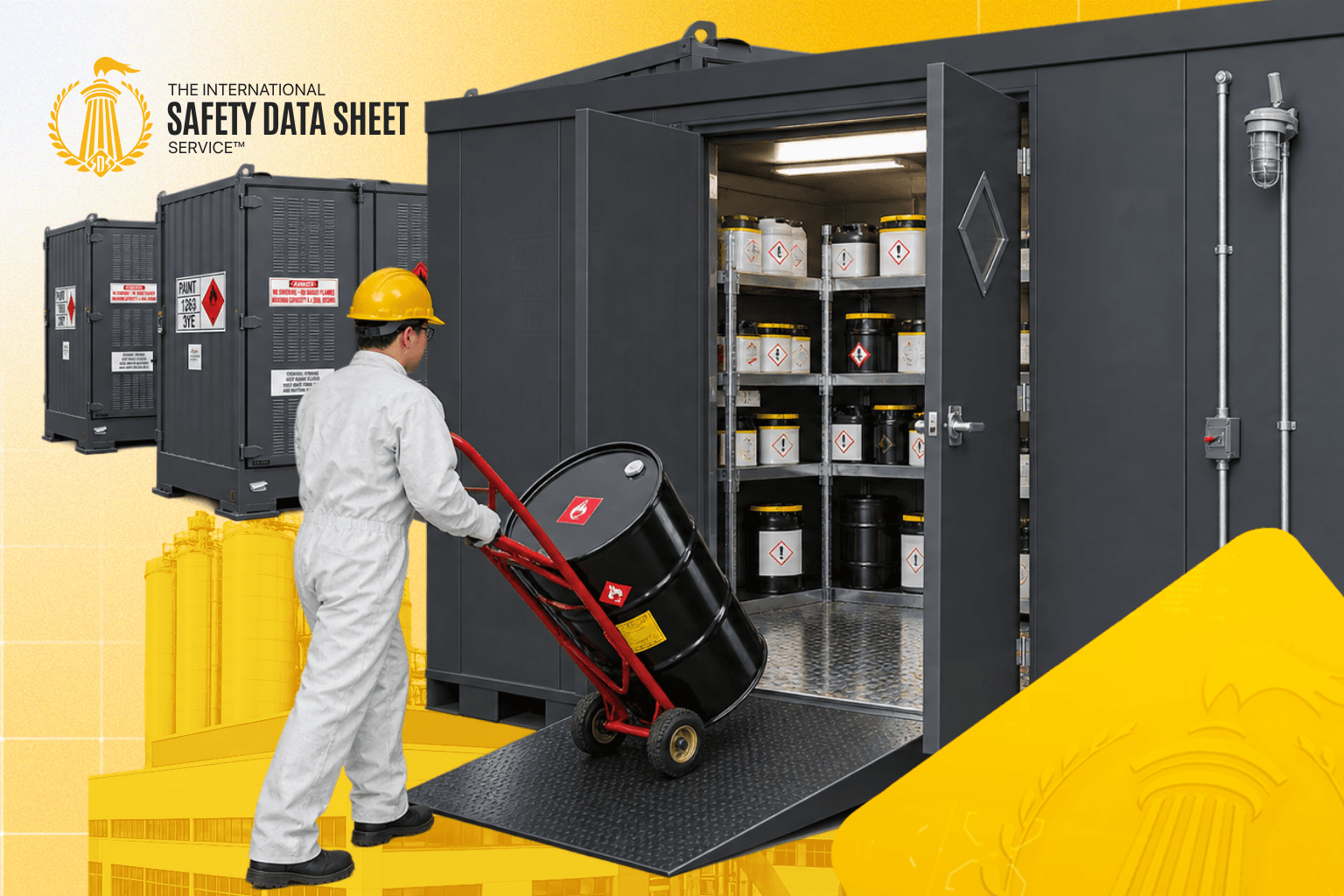
Safe Chemical Storage: A Segregation Checklist by Hazard Class
Safe chemical storage means grouping substances by their GHS/CLP hazard classification and keeping incompatible classes apart, such as oxidisers away from flammables, with extra legal requirements under DSEAR for anything that poses a fire or explosion risk.
On this page
- Start from the classification, not the shelf
- Keep incompatible hazard classes apart
- Flammable and oxidising substances have their own legal storage duty
- Everything else falls under COSHH's general storage duty
- Ventilation and spill containment are part of the design, not an afterthought
- Where and how much: dedicated storage versus workroom quantities
- Frequently Asked Questions
There isn't one single "chemical storage regulation" to check against. Storage sits across three different sources: DSEAR for substances that pose a fire or explosion risk, COSHH's general duty to control exposure for everything else hazardous, and HSE's own HSG71 guidance for the practical segregation grouping that ties back to a substance's GHS/CLP hazard classification. This checklist walks through what each one actually requires.
Start from the classification, not the shelf
Segregation decisions should follow the hazard classification on the label and in Section 2 of the substance's Safety Data Sheet, not the shape of the container or how the product happens to be used day to day. Two products that look similar on a shelf, a cleaning fluid and a pool chemical, for example, can carry entirely different classifications and need to be kept apart for entirely different reasons. Working from the classification first is what makes segregation decisions consistent rather than a judgement call made on the spot by whoever is unpacking a delivery.
Keep incompatible hazard classes apart
HSE's HSG71 guidance on chemical warehousing sets out the practical measures for segregating incompatible substances, built around the principle that certain hazard classes should never share a storage area, container run or drainage path. Oxidisers stored next to flammables, or corrosives next to reactive metals, turn a contained spill into a fire, an explosion or a toxic gas release rather than a cleanup job.
This applies to mixtures too, not just pure substances. A flammable solvent held inside another product, such as an aerosol or a diluted cleaning fluid, still carries the flammability hazard of what's dissolved in it, and shouldn't be stored in the same cabinet or bin as other flammable liquids simply because the container looks different.
Some incompatible pairings are common enough to be worth naming directly. Bleach and ammonia-based cleaners, stored side by side in general-purpose cleaning cupboards, can react to release toxic chloramine gas if containers leak into each other. Acids stored near cyanide-containing substances can generate lethal hydrogen cyanide gas on contact. Neither pairing looks obviously dangerous on a shelf, since both halves are everyday workplace products rather than exotic industrial chemicals, which is exactly why classification-based segregation matters more than instinct about what looks risky.
Flammable and oxidising substances have their own legal storage duty
Where a substance is classified as explosive, oxidising or flammable, DSEAR requires the employer's risk assessment to specifically cover the arrangements for its safe storage, alongside its handling and transport. This is a distinct legal duty from COSHH's general control-of-exposure requirement, triggered by the fire and explosion risk rather than a health hazard.
HSE's practical guidance puts numbers on this for workroom storage: no more than 50 litres of highly flammable liquid, or any flammable liquid with a flash point below the room's maximum ambient temperature, and no more than 250 litres of other flammable liquids with a flash point up to 60°C, should be kept in cabinets or bins within a workroom or working area (HSE guidance on storing flammable liquids in workrooms).
Beyond those quantities, HSE's guidance on storing flammable liquids in containers applies instead, covering dedicated storage areas outside the main working space.
Everything else falls under COSHH's general storage duty
Corrosives, toxic substances and other health hazards that aren't flammable or oxidising don't fall under DSEAR, but they're not exempt from control either. Regulation 7 of COSHH requires exposure to be prevented or adequately controlled, and how a substance is stored, whether that's a sealed container, a bunded area to contain leaks, or simply keeping it away from where food is prepared or eaten, is part of that control. There's no separate statutory storage checklist for these substances the way there is for flammables under DSEAR; the general duty to control exposure covers it.
In practice this usually means matching the container to the hazard rather than defaulting to whatever's on hand. Corrosive liquids need containers that won't be eaten through over time, acute toxicants are often kept locked away with restricted access rather than on an open shelf, and anything that could contaminate food needs physical separation from food storage and preparation areas, not just a different shelf in the same cupboard.
Ventilation and spill containment are part of the design, not an afterthought
HSG71 treats building design as core to safe storage, not a detail to fix later. Its guidance covers ventilation requirements for storage buildings and areas, and separately sets out the measures needed for spill control (HSE, HSG71). Poor ventilation lets vapours from flammable or toxic substances build up in a confined space; inadequate bunding turns one leaking drum into a spill that reaches the rest of the storage area, or a drain.
This matters most for substances classified as hazardous to the environment. A spill that reaches a drain or watercourse is not just a workplace safety issue at that point, it's a separate environmental exposure with its own legal consequences, which is why bunding and drainage control get treated as their own dedicated part of HSE's storage guidance rather than folded into general housekeeping advice.
Where and how much: dedicated storage versus workroom quantities
Small working quantities kept close to where a substance is actually used are one thing; bulk stock is another. Dedicated storage areas need their own ventilation, spill containment and, for flammables, distance from ignition sources, and they should be sized so that nobody has to fetch a full day's stock from a container designed for occasional top-ups. A cabinet rated for cleaning products in a workroom is not the same as a warehouse storage bay, and treating the two interchangeably is one of the more common gaps HSG71 flags in inspections. Access matters too: a storage area that's easy to reach for routine restocking but hard to walk past unnoticed if a door's been left open or a container's been left out is doing its job; one that's either locked away and inconvenient enough that people start keeping working stock elsewhere, or so casual that anyone passing through can help themselves, tends to fail in practice regardless of what the risk assessment says on paper.
Frequently Asked Questions
Can I store all my flammable products together regardless of what else is in them?
Not automatically. HSE's guidance specifically notes that other dangerous substances, such as oxidisers or corrosives, may themselves be flammable liquids or be held inside one, but it's still inappropriate to store these in the same cabinet or bin as other flammable liquids (HSE guidance on storing flammable liquids in workrooms (opens in new tab)). The classification of what's inside the container matters more than what the container looks like.
Does COSHH itself specify exact segregation groups for chemical storage?
No. COSHH sets the general duty to prevent or control exposure, but the specific segregation groupings, keeping oxidisers away from flammables, corrosives away from reactive metals, and so on, come from HSE's HSG71 guidance (opens in new tab) rather than the Regulations themselves. Following it is best practice and the standard HSE inspectors expect to see, even though it isn't a separate statutory instrument in its own right.
What's the maximum amount of flammable liquid I can keep in a workroom?
Up to 50 litres of highly flammable liquid, or any liquid with a flash point below the room's maximum ambient temperature, and up to 250 litres of other flammable liquids with a flash point up to 60°C, kept in cabinets or bins (HSE guidance on storing flammable liquids in workrooms (opens in new tab)). Anything beyond that needs dedicated storage covered by separate HSE guidance, not a bigger cabinet in the same room.
Do small quantities of incompatible chemicals need the same segregation as bulk storage?
The segregation principle applies regardless of volume; a small bottle of oxidiser next to a small bottle of solvent can still react if they come into contact. What changes with quantity is the scale of the consequence and, for flammables specifically, whether DSEAR's workroom limits or its dedicated-storage requirements apply. Small scale doesn't mean the segregation rule stops applying, only that the practical arrangements (a divided cabinet rather than a separate building) may look different.
Who is responsible for getting chemical storage arrangements right?
The employer, under both COSHH and DSEAR. A competent person, a health and safety manager or an external consultant can be asked to design and check the storage arrangements, but appointing someone to do the work doesn't transfer the underlying legal duty away from the employer.
You Might Also Find Useful
Free SDS and Chemical Risk Assessments
Search more than 1.5 million Safety Data Sheets and linked Chemical Risk Assessments.
- ✓ Search by substance, product, or manufacturer
- ✓ Save documents to your library
- ✓ Register free in under two minutes