What Is Section 8 of a Safety Data Sheet?
Section 8 of a Safety Data Sheet (SDS) covers exposure controls and personal protection.
On this page
It sets out the workplace exposure limits that apply to a substance, the engineering controls needed to keep airborne concentrations down, and the personal protective equipment (PPE) required once those controls are in place. Of the sixteen standard SDS sections, it's the one most directly used to decide what actually happens on site.
The Two Parts of Section 8
Section 8 follows the same 16-section structure used worldwide under the UN's Globally Harmonised System (GHS), which UK CLP and UK REACH both implement domestically. The European Chemicals Agency (ECHA) sets out the same structure for the wider EU market, which is why the format looks identical whether a supplier is based in Manchester or Munich. Section 8 itself splits into two subsections, and it's worth knowing the difference because they answer different questions.
8.1 Control parameters
The supplier lists any occupational exposure limits that apply to the substance or its components here, along with the source of those figures (for a UK-supplied SDS, that should be the HSE's EH40/2005 list, not an EU or US limit carried over from an international dataset). It also covers biological limit values where relevant, such as blood or urine thresholds used in health surveillance.
8.2 Exposure controls
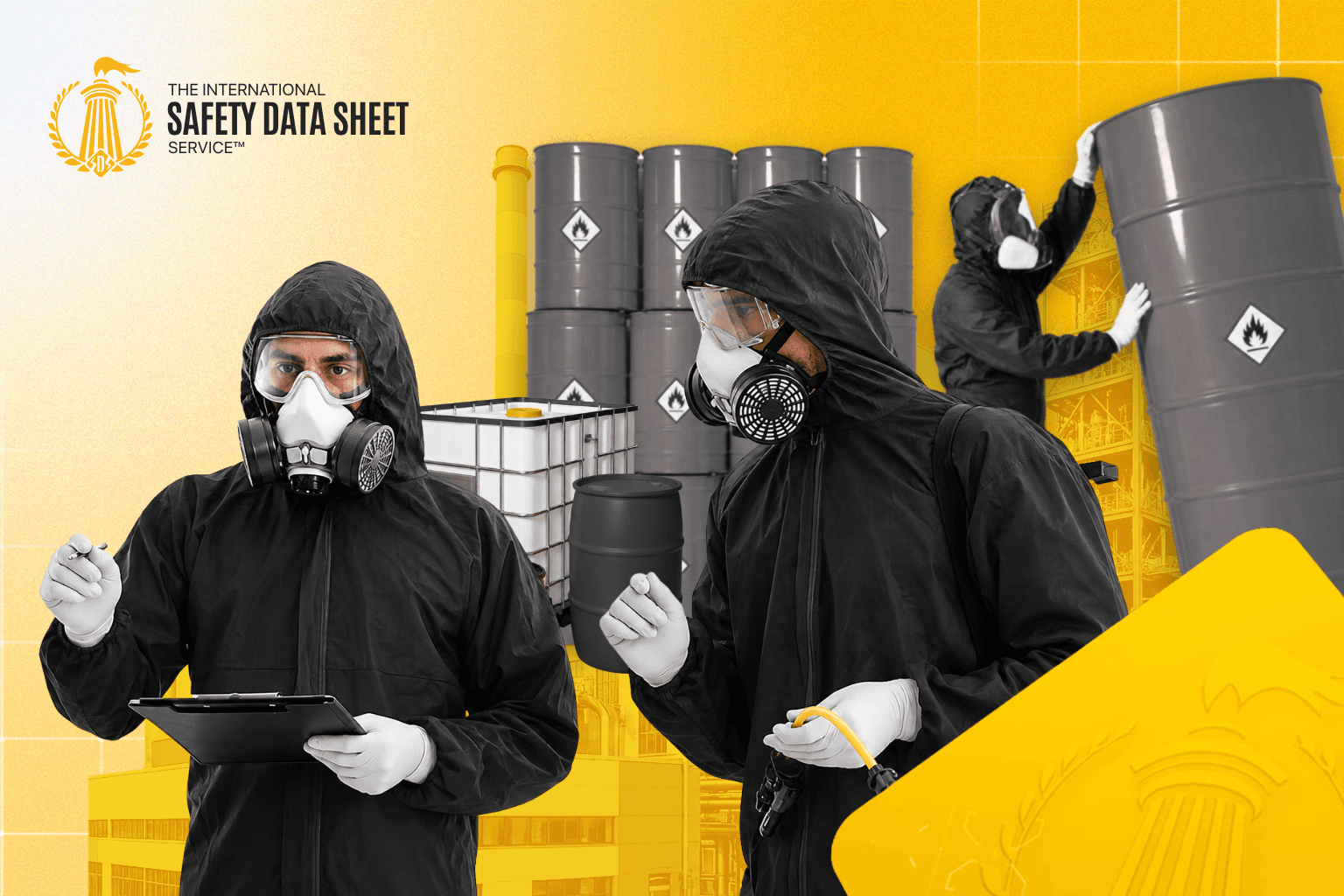
The practical half sits here: appropriate engineering controls (such as local exhaust ventilation), and individual protection measures broken down by route of exposure, eye and face protection, skin protection (usually gloves, sometimes full protective clothing), respiratory protection, and thermal hazards where they apply.
Read together, 8.1 tells you the target and 8.2 tells you how suppliers suggest you hit it.
Workplace Exposure Limits, Explained
A Workplace Exposure Limit (WEL) is the maximum concentration of a hazardous substance in workplace air that a worker can be exposed to, averaged over a set reference period. The HSE publishes and maintains these limits in a document called EH40/2005, updated periodically as new evidence comes in.
WELs come in two forms. A long-term exposure limit (LTEL) is an 8-hour time-weighted average, meant to protect against the cumulative effects of exposure across a shift. A short-term exposure limit (STEL) is a 15-minute reference period, meant to catch brief peak exposures that an 8-hour average would smooth over and hide. Toluene, a common industrial solvent, illustrates the pattern: its UK WEL is 50 ppm as an 8-hour TWA, with a 100 ppm STEL for short bursts.
WELs sit within the wider COSHH Regulations 2002, and the current edition of EH40 is the authoritative GB list. Check the current EH40 entry when using an exposure limit; the age of an SDS alone does not prove that its figure is wrong, but an older document may not reflect a later revision.
Not every substance has a WEL. Its absence does not mean the substance is safe at any concentration, only that HSE has not set a specific numerical limit. Check the current EH40 list and use the other hazard and exposure information in the SDS and COSHH assessment.
Why PPE Comes Last, Not First
COSHH doesn't treat PPE as the default answer. Regulation 7 sets out a hierarchy: eliminate the substance if you can, substitute it for something less hazardous if you can't, then reduce exposure through engineering controls, then through administrative controls (changing how the work is done), and only then fall back on PPE. Section 8's own structure mirrors this. HSE guidance is direct on the point: PPE should be the last resort, used to catch whatever risk remains once the higher-order controls are in place, not as a substitute for them.
PPE protects one person, and only while it's correctly fitted, maintained, and actually worn. Engineering controls protect everyone in the space, whether or not they remember to put anything on. In practice, the engineering controls Section 8 points to tend to be one of a handful of familiar options:
- Local exhaust ventilation (LEV), extraction fitted close to where a substance is generated
- General or dilution ventilation, for lower-risk tasks where LEV isn't justified
- Enclosing or isolating the process so the substance doesn't reach open air at all
- Wet methods, such as wet cutting, to stop dust becoming airborne in the first place
That distinction between engineering controls and PPE is easiest to see with a real example.
What This Looks Like in Practice: Solent Just Orange Solvent Degreaser
The Solent Just Orange Solvent Degreaser SDS on ISDSS is a useful real-world case. It's classified for skin irritation, skin sensitisation, and an aspiration hazard (a warning that the product may be fatal if swallowed and it enters the airways), a hazard profile typical of citrus and hydrocarbon-based degreasers.
An aspiration hazard means the liquid may cause severe harm if it enters the airways, usually during swallowing or vomiting; it is not a classification for ordinary inhalation of vapour or mist. Section 8 still matters because the product's skin-sensitisation and irritation hazards, its volatile components and the way it is used all affect the controls. The product SDS and COSHH assessment must determine whether enclosure, ventilation, gloves, eye protection or RPE are needed. The classification alone is not enough to prescribe those controls.
Reading the PPE Recommendations Correctly
Section 8's PPE guidance only works if it's specific. Glove recommendations should name a material, nitrile, neoprene, butyl, or similar, because chemical resistance varies hugely between them and the wrong material can offer a false sense of security rather than genuine protection. Respiratory protective equipment (RPE) should specify a filter type matched to the actual hazard: a particulate filter does nothing against organic vapour, and vice versa.
If Section 8 gives only generic PPE wording, ask the supplier for enough information to select protection for the task. The SDS may need to be read with the manufacturer's technical guidance and the workplace assessment; generic wording alone does not establish that the SDS is legally defective.
Using Section 8 in a COSHH Risk Assessment
The logic runs in a straight line: the SDS identifies the hazards, Section 8 explains how to control them, and a COSHH risk assessment applies those recommendations to the actual workplace.
Section 8 doesn't replace a COSHH risk assessment. It feeds into one. Once you've identified the hazards (Sections 2 and 3 of the SDS) and how the substance is actually handled on site, Section 8 supplies the control parameters and starting-point controls you then adapt to the specific task, quantity and exposure duration in your own workplace. Our guide to how to carry out a COSHH risk assessment covers that process step by step, including where Section 8 data slots into it.
If you're still getting familiar with the SDS format as a whole, our overview of Safety Data Sheets walks through all sixteen sections and where each one fits, and our piece on SDS vs MSDS explains why the older US-style MSDS format doesn't map cleanly onto this structure.
Common Mistakes to Avoid
- Treating Section 8's PPE list as the complete control measure, rather than the last layer after elimination, substitution, engineering and administrative controls have been considered
- Using an exposure limit without checking it's sourced from the current EH40 edition, rather than an older figure or a limit set for a different country
- Accepting vague PPE wording ("wear appropriate protection") instead of the specific glove material, filter type or eyewear standard the task actually needs
- Working from an outdated SDS after a substance's classification or exposure limit has been revised
Frequently Asked Questions
What are the two subsections of Section 8?
Section 8.1 covers control parameters, mainly workplace exposure limits and their source. Section 8.2 covers exposure controls: engineering measures and personal protective equipment, broken down by eye, skin and respiratory protection.
Does Section 8 tell me exactly what PPE to buy?
It's a starting point, not a purchase order. Section 8 gives supplier recommendations based on the substance's hazards, but the specific equipment still needs to be matched to how much of the substance is used, for how long, and under what conditions at your site, which is what a COSHH risk assessment is for.
What if a substance has no listed Workplace Exposure Limit?
No WEL doesn't mean no risk. It means HSE hasn't set a specific numerical limit for that substance. Employers still have to control exposure as far as reasonably practicable under COSHH, using the hazard information elsewhere in the SDS to judge appropriate controls.
Who is responsible for acting on Section 8?
The supplier's duty is to provide accurate information in Section 8. The employer's duty under COSHH is to use that information to prevent or adequately control exposure at their own site, including selecting and maintaining the right PPE and engineering controls.
How often do workplace exposure limits change?
There's no fixed schedule. HSE reviews and updates EH40 as new evidence becomes available, so it's worth checking the current EH40 edition periodically rather than assuming the limits on file are still current.
You Might Also Find Useful
Free SDS and Chemical Risk Assessments
Search more than 1.5 million Safety Data Sheets and linked Chemical Risk Assessments.
- ✓ Search by substance, product, or manufacturer
- ✓ Save documents to your library
- ✓ Register free in under two minutes