Glass Cleaner SDS Explained: Why Formulations Differ
Two glass cleaners can look identical on the shelf and still carry completely different hazard classifications. The SDS for the exact product is where the difference shows.
On this page
- Two Unrelated Approaches
- Why the Classification Changes With the Formulation
- Reading Sections 2 and 3
- What Isopropyl Alcohol's Presence Does and Doesn't Tell You
- Why This Isn't a Composition List for Any One Brand
- Great Britain vs Northern Ireland
- What This Means for COSHH and PPE
- Which Sections Help You Compare Two Glass Cleaners
- Frequently Asked Questions
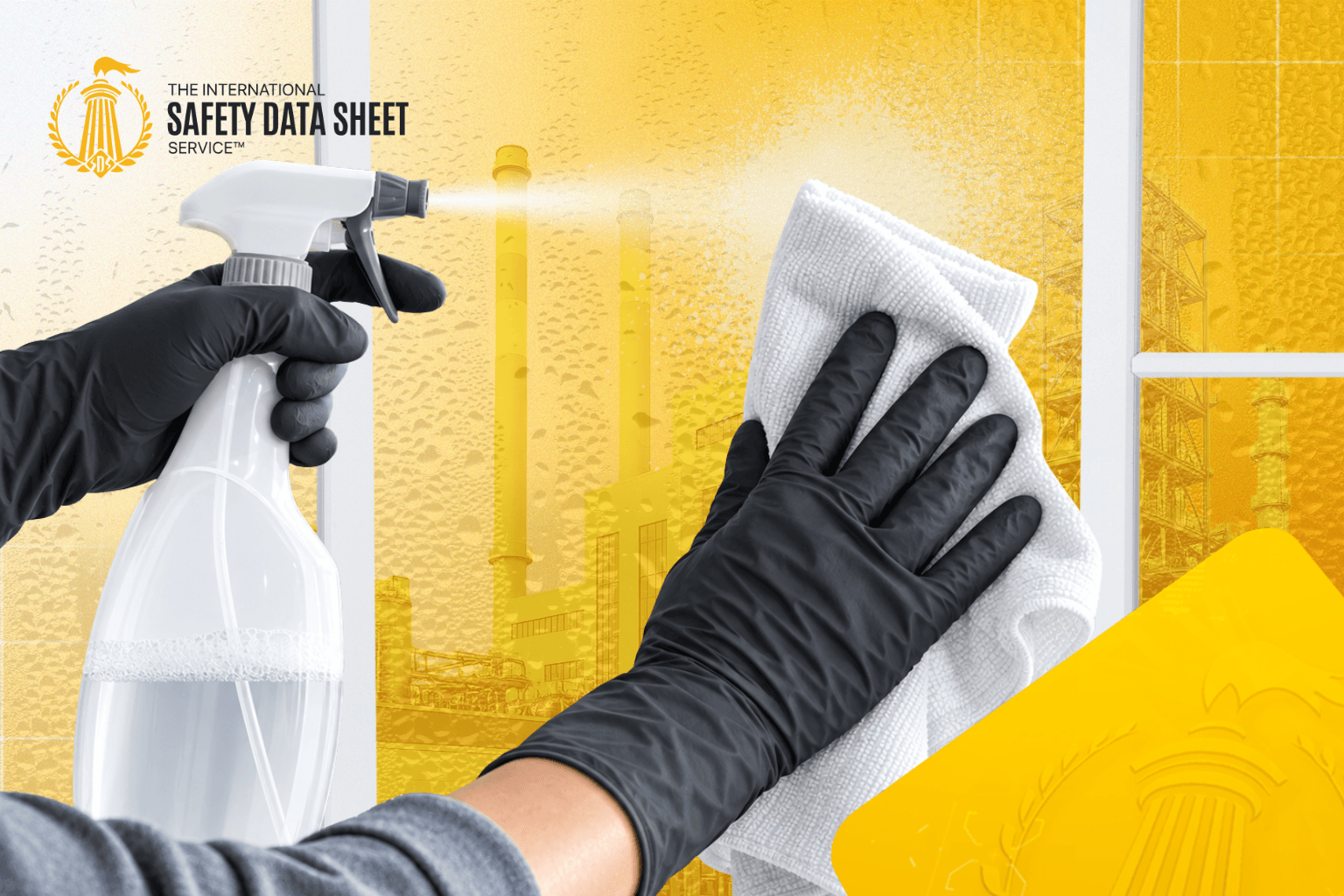
Pick up two bottles labelled “glass cleaner” and you're not necessarily holding the same kind of product twice. “Glass cleaner” describes what something is used for, not what's in it. Suppliers choose their own combination of solvents, surfactants, fragrances and other additives, in their own concentrations, to balance cleaning performance, streak-free drying and cost, and there's no single recipe behind the name. One bottle may carry a flammable warning and the other none, and both can be entirely correct. The SDS for the exact product tells you which applies, so a COSHH assessment should never borrow a classification from a different bottle.
Two Unrelated Approaches
Real, independently-checked UK glass cleaner SDSs show at least two distinct formulation families on the market. One real aerosol glass cleaner's SDS lists isopropyl alcohol at 30–60% by weight, with ammonia under 1%. Because it's an aerosol with that much alcohol, it classifies as an extremely flammable aerosol (H222), with a pressurised-container warning (H229), serious eye irritation (H319) and drowsiness or dizziness from vapour (H336). Signal word: Danger, driven mainly by flammability and pressurisation.
A completely different real example, a UK trigger-spray product for trade use, contains no flammable alcohol at all. Its composition is built around two surfactants and a mild acid, none of them flammable. Its SDS still carries signal word Danger, but for an unrelated reason: the combined ingredients cause serious eye damage (H318), with the product also rated harmful to aquatic life long-term (H412). Same signal word, same general product category, two unrelated reasons for it, which is the core of why “Danger” on a glass cleaner's label tells you caution is warranted but nothing about which caution, flammability, eye damage, or something else again, without reading the hazard statements themselves.
Why the Classification Changes With the Formulation
Under GB CLP, suppliers must classify and label a mixture according to its constituent substances and their concentrations, so changing an ingredient, or its concentration, can change the classification. HSE's guidance on cleaning products makes this concrete for eye hazards specifically: serious eye damage (Category 1, H318, corrosive pictogram, irreversible effects) and eye irritation (Category 2, H319, exclamation mark pictogram, reversible effects) are separate classifications, and the two pictograms are easy to conflate since the corrosive symbol also covers skin corrosion and the exclamation mark also covers skin irritants. HSE is explicit that a pictogram is only one part of a label, the hazard and precautionary statements carry the real detail, so a pictogram's presence or absence on a given bottle doesn't tell the full story on its own.
Physical hazards add a second axis on top of this. A flammable solvent, or a product supplied as an aerosol, brings fire and pressure hazards that a water-based trigger spray doesn't, regardless of what's driving the health-hazard classification. The task matters too: spraying creates a different exposure from wiping with a cloth, and pouring a concentrate creates a different splash risk from using a ready-to-use spray.
Reading Sections 2 and 3
Section 2 is the quickest route to a product's classification: signal word, pictograms, hazard statements and precautionary statements for that specific mixture. Two products sold for the same job can legitimately show different Section 2 information, that's a sign the formulations differ, not that one document is wrong.
Section 3 lists the hazardous ingredients that contribute to the classification, with concentration information where disclosure rules require it, though it's not a full recipe, non-hazardous ingredients and some concentration detail may not appear. ECHA's mixture classification guidance explains that classifiers need the identity, concentration and classification of each substance in a mixture, including any specific concentration limits, which is why Section 3 exists as a distinct section from Section 2 rather than being folded into it. The content and structure of the 16-section SDS format itself is set by Annex II of UK REACH.
What Isopropyl Alcohol's Presence Does and Doesn't Tell You
When isopropyl alcohol is present in a glass cleaner, it brings its own fixed hazard profile, Flam. Liq. Category 2 (H225), serious eye irritation (H319) and drowsiness or dizziness (H336), covered in full in our dedicated IPA article. What changes between glass cleaners isn't IPA's hazard profile, that's fixed by the substance itself, it's whether a given formulation contains IPA at all, at what concentration, and in what delivery format, since aerosol propellant adds its own flammability and pressurisation hazards on top of whatever solvent is present.
Why This Isn't a Composition List for Any One Brand
Composition and concentration figures are specific to one manufacturer's formulation at one point in time, and a formulation can change between SDS revisions without the product name or packaging changing at all. The only way to know what's actually in the glass cleaner on your shelf is its own current SDS, not a generalisation from other products in the same category, no matter how similar they sound. It's also worth checking the SDS revision date itself: an SDS still built around the older, pre-2015 CHIP classification system rather than current CLP is a sign the document may be out of date, not necessarily that the product's hazards have changed, but worth confirming with the supplier before relying on it.
Great Britain vs Northern Ireland
In Great Britain, substances and mixtures placed on the market fall under GB CLP. Northern Ireland continues to follow EU CLP for products placed on its market, under the Windsor Framework. If your business operates across the UK, use the SDS and classification that apply to the market the specific product was actually supplied into, not whichever one is easiest to find.
What This Means for COSHH and PPE
The SDS is an input to a COSHH assessment, not a replacement for it. It holds the information an employer needs, but the assessment itself has to consider how the product is actually used, how often, by whom, and by which route of exposure. The formulation difference changes what that assessment should focus on in practice: an alcohol-based or aerosol product brings ignition-source rules into play, store away from heat and ignition, ventilate a spill before cleaning it up, while an alcohol-free, acid/surfactant-based product's main concerns are skin and eye contact and, because of aquatic-toxicity ratings some carry, not pouring concentrate or rinse water down a drain in bulk. PPE guidance follows the same split, an alcohol-based product's SDS is more likely to emphasise ventilation and vapour exposure, an acid/surfactant-based one more likely to emphasise splash and skin protection. A business that trains staff on one formulation and then switches supplier to the other type, while still calling it “glass cleaner” on the schedule, can end up prepared for the wrong hazard entirely, and a blanket “glass cleaner: low risk” line on a COSHH assessment doesn't hold up once that's tested.
Which Sections Help You Compare Two Glass Cleaners
- Section 2: classification, signal word, pictograms and hazard statements
- Section 3: hazardous ingredients and any disclosed concentrations
- Section 4: first-aid advice for each route of exposure
- Section 7: handling and storage instructions
- Section 8: exposure limits, controls and PPE
- Section 9: physical state, pH and flash point where relevant
Frequently Asked Questions
Are all glass cleaners flammable?
No. Some are alcohol-based and flammable, particularly in aerosol formats. Others contain no flammable alcohol at all and are built around surfactants and a mild acid instead. Check Section 2 and Section 9 of the specific product's SDS to know which applies.
Why do two glass cleaners both show “Danger” if they're made differently?
Danger is CLP's more severe signal word, and more than one hazard class can trigger it. An alcohol-based aerosol cleaner can earn Danger through flammability and pressurisation, while an alcohol-free trigger-spray cleaner can earn the same signal word through serious eye damage. The signal word alone doesn't tell you which hazard applies, the hazard statements do.
Can I use one glass cleaner's SDS for a different brand?
No. Each SDS describes one supplier's specific mixture at one point in time. Search for the exact product you use rather than assuming it matches a similar-sounding one.
Does a glass cleaner need a COSHH assessment?
It can. If the product is classified as hazardous, COSHH applies to its workplace use. The SDS tells you whether it's classified as hazardous, and the assessment covers how you actually use it.
What if my glass cleaner's SDS looks old?
Ask the supplier for a current one. An SDS still built on the pre-2015 CHIP classification system rather than current CLP is a sign the document itself may not reflect current classification rules, whatever the product's actual hazards are today.
You Might Also Find Useful
Free SDS and Chemical Risk Assessments
Search more than 1.5 million Safety Data Sheets and linked Chemical Risk Assessments.
- ✓ Search by substance, product, or manufacturer
- ✓ Save documents to your library
- ✓ Register free in under two minutes