H-Phrases and P-Phrases: What They Mean on a Safety Data Sheet
H-phrases describe what a chemical hazard is. P-phrases tell you what to do about it.
Both appear in Section 2 of every Safety Data Sheet, and together they give you the two most actionable pieces of information on the document: the nature of the risk and the response it requires.
They are standardised codes under the Globally Harmonized System, which means an H302 or P260 means exactly the same thing regardless of which manufacturer produced the SDS or which country it was made in. Once you know what the codes mean, you can read the hazard profile of any substance quickly and accurately, without needing to parse a wall of technical text.
What Are H-Phrases?
H-phrases are standardised hazard statements. Each one is a short sentence describing a specific type of hazard associated with a substance, and each is assigned a unique code beginning with H. They are defined under the UN Globally Harmonized System (GHS) and written into UK law via the CLP Regulation.
The H-phrase numbering system is organised into three series:
- H2xx Physical hazards: flammability, explosivity, oxidising properties, gases under pressure
- H3xx Health hazards: acute toxicity, skin and eye effects, respiratory sensitisation, carcinogenicity, reproductive toxicity, organ damage
- H4xx Environmental hazards: aquatic toxicity, ozone depletion
A substance can carry multiple H-phrases if it presents multiple distinct hazards. That is the norm rather than the exception for anything more complex than a single-ingredient substance.
What Are P-Phrases?
P-phrases are precautionary statements. Where H-phrases describe the hazard, P-phrases describe the response. Each one is a specific instruction on how to handle, store, or respond to a substance safely. They also carry codes beginning with P, defined under the same GHS and CLP framework.
The P-phrase series runs across five categories:
- P1xx General: P101 (if medical advice needed, keep product container/label at hand)
- P2xx Prevention: what to do before and during use to avoid exposure
- P3xx Response: what to do if something goes wrong: accidental exposure, fire, spill
- P4xx Storage: correct conditions for keeping the substance safely
- P5xx Disposal: how to dispose of the substance and its container correctly
P-phrases can be combined into a single statement when the instructions are closely related. P264+P270, for example, combines “wash hands thoroughly after handling” with “do not eat, drink or smoke when using this product.” This is why you will sometimes see P-phrases with a plus sign between codes rather than each listed separately.
Where H-Phrases and P-Phrases Appear on an SDS
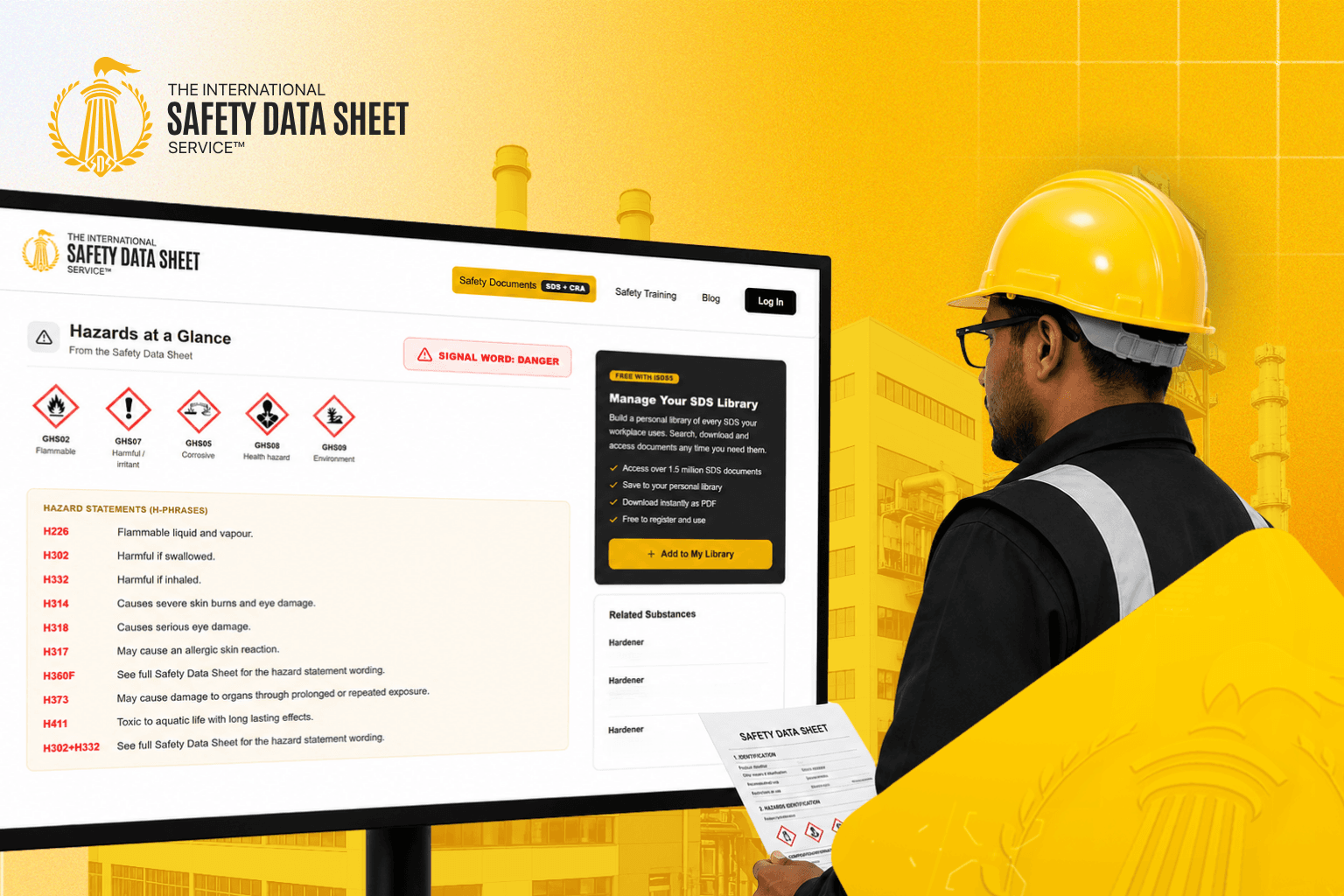
Both appear in Section 2 of the Safety Data Sheet, which covers hazard identification. This is typically the first section most people turn to when they want a quick read of what a substance is capable of and what handling it requires. The current 16-section SDS format places all hazard classification information here, including the GHS hazard pictograms, the signal word (Danger or Warning), and the full list of H-phrases and P-phrases that apply to that substance.
H-phrases also appear again in Section 11 (Toxicological Information) where the specific health effects behind each statement are explained in more detail. P-phrases relating to first aid appear in Section 4, and those relating to firefighting and accidental release appear in Sections 5 and 6 respectively. Section 2 gives you the summary; the later sections give you the detail behind each statement.
What They Look Like in Practice: Formaldehyde
Formaldehyde is a useful example because it carries a substantial set of H-phrases that span multiple hazard categories. The Safety Data Sheet for Formalin (Formaldehyde 40%) on ISDSS carries hazard statements covering flammability (H228), acute toxicity by inhalation and ingestion (H301, H331), skin corrosion (H314), skin sensitisation (H317), carcinogenicity (H350), and organ damage (H372). Each of those H-phrases maps directly to a set of P-phrases in the same Section 2, so P260 (do not breathe vapours), P271 (use only in well-ventilated areas), and P284 (wear respiratory protection) all follow from the acute inhalation toxicity and sensitisation classifications.
The P-phrases are not generic safety advice. They are specific responses derived directly from the H-phrase profile. Where the H-phrases tell you formaldehyde can cause cancer (H350) and damage organs through repeated exposure (H372), the corresponding P-phrases specify avoiding repeated exposure, obtaining medical advice if concerned, and wearing appropriate PPE when in contact with the substance. One set of codes tells you the risk; the other tells you the control.
Why H-Phrases and P-Phrases Matter for COSHH
Under COSHH, employers must assess the health risks posed by hazardous substances before work begins. The H-phrases on a substance's SDS are the starting point for that assessment: they define which hazard categories apply, which exposure routes to consider, and which effects need to be controlled. A COSHH risk assessment that ignores or misreads the H-phrases of the substances involved is not a proper assessment.
The P-phrases then feed directly into the control measures section of that assessment. If Section 2 carries P285 (in case of inadequate ventilation wear respiratory protection), that is not a suggestion. It is a control measure derived from the substance's known properties and regulatory classification, and it should appear in the assessment alongside the task and exposure information it relates to.
This is why having the correct, current SDS for every substance your workplace uses is not simply a filing exercise. The H-phrases and P-phrases on that document are the technical basis for understanding what risks exist and what controls are required. An outdated SDS with superseded classifications can mean your risk assessment is built on inaccurate hazard data.
H-Phrases, R-Phrases, and What Changed
If you have been working with chemicals for a while, you may remember R-phrases (risk phrases) and S-phrases (safety phrases) on older MSDS documents. These were the predecessor system before GHS standardisation. H-phrases replaced R-phrases and P-phrases replaced S-phrases when the CLP Regulation came into force, with full compliance required for mixtures from 2015.
The core purpose is the same but the codes are different, and they do not map one-to-one. R45 (may cause cancer) became H350 (may cause cancer). R34 (causes burns) became H314 (causes severe skin burns and eye damage). If your workplace still has any MSDS documents using R/S-phrases rather than H/P-phrases, those documents are out of date and should be replaced with current SDS documents using the GHS system.
Frequently Asked Questions
What is the difference between H-phrases and P-phrases?
H-phrases are hazard statements that describe what a substance can do: the type and severity of risk it presents. P-phrases are precautionary statements that describe what you should do in response: how to handle, store and respond to the substance safely. Both appear in Section 2 of a Safety Data Sheet.
Where do H-phrases and P-phrases appear on an SDS?
Both are listed in Section 2 (Hazard Identification) of the Safety Data Sheet. H-phrases also appear in Section 11 where their health effects are explained in more detail. P-phrases relating to first aid, firefighting and accidental release are expanded in Sections 4, 5 and 6.
What do the numbers in H-phrases mean?
The numbering system identifies the hazard category. H2xx codes cover physical hazards such as flammability and explosivity. H3xx codes cover health hazards including toxicity, skin and eye effects, carcinogenicity and organ damage. H4xx codes cover environmental hazards such as aquatic toxicity. The specific number within each series identifies the precise hazard.
Are H-phrases the same as R-phrases?
No. R-phrases were the predecessor system used on MSDS documents before the current GHS-aligned SDS format came in. H-phrases replaced R-phrases when the CLP Regulation took effect, with full compliance required from 2015. The codes are different and do not map directly to each other. If a document still uses R-phrases, it predates the current format and should be replaced.
Can a substance have more than one H-phrase?
Yes, and most hazardous substances do. A single substance can carry H-phrases covering multiple hazard categories simultaneously: flammable, toxic, and an eye irritant at the same time, for example. All applicable H-phrases are listed in Section 2 of the SDS, and each one corresponds to a set of P-phrases describing the appropriate precautions.
You Might Also Find Useful
Free SDS and Chemical Risk Assessments
Search more than 1.5 million Safety Data Sheets and linked Chemical Risk Assessments.
- ✓ Search by substance, product, or manufacturer
- ✓ Save documents to your library
- ✓ Register free in under two minutes